I am beginning to get a little frantic on building my educational game, but working through. The project has some challenges I did not completely anticipate and have forced me to pivot a little on how the game will go. This is not necessarily a bad thing, as I ended up following a lot of trails in directions I did not fully expect. Laura Ingalls Wider and I, exploring new lands.
The Good: In the past few years, a lot of people have taken up her books as a framework for their arguments, whether it be societal expectations, misunderstanding or misrepresenting illnesses, or the hard truth that her stories also tell about the large scale displacement of Native Americans. To find the ideas I wanted to follow in the game, I reread all the books except Farmer Boy about Almanzo Wilder’s childhood and The First Four Years covering the early days of marriage. Reading as an adult, the stories are very different, for while Laura remains a plucky heroine, it is inescapable to look at the racism, varying from mild to very; think about child labor as she goes to work at fourteen to help her family; and how hard life as a homesteader was and how economically tenuous. I cannot add all these in a game, but it was interesting. I was able to fix some of that she tells to events happening in the world, which will help the game play.
The Bad: In spite of all the work being done, few of her letters are digitized and online. There are a handful, and some family correspondence online at in the excellent Turning Points in Wisconsin History collection at https://www.wisconsinhistory.org. I have had to work the edges of the problem, leading me to focus more on the story through the lens of treaties and legislation, combined with periodicals and maps more than letters. It has been tough, but I think workable.
The Ugly: I am behind schedule, fixating on how to use FigJam for storyboarding and starting to use Twine. I can catch up, but me next few weeks will be a little ugly.
I am not of the Oregon Trail age, in school in the Dark Ages before computers of any kind were common in schools and dot matrix printers a wonder on the horizon. So I am intrigued by games as education as they were not generally part of mine. Gaming has become a part of classroom instruction, whether a simple game to learn numbers and letters, or the use of Assassin’s Creed or Red Dead Redemption for older students. As I try to create one of my own, research into user needs leaves me intrigued by the possibilities.
My original plan was to target at least the younger end of the high school age group to a middle school age, group. Reading on educational games as they are used by different levels of education, though, I am narrowing the target ages to middle schoolers. Middle school educators, according to an Iowa State University study, prefer games that are challenging vice competitive.1
This supports the results of the interviews conducted earlier to develop personas, both of whom used educational games. Both of them wanted games that required the players to do research and understand a concept, instead of just jumping through rote memorization challenges. The game I’m developing will hopefully engage users with requiring a combination of skills and offering paths to do more reading of primary sources to understand issues.
Adventures West: Laura Ingalls Wilder from the Little Cabin to the Little Grey House will be an educational game based on the text of the Little House on the Prairie series, not including Farmer Boy and The First Four Years. Also not addressed is the period not covered in her works, when the family lived in Iowa. Not using that period was an editorial decision of Wilder and her daughter, Rose WIlder Lane, to keep the story coherent. 1Wilder’s first book, Little House in the Big Woods was first published in 1932, followed by another eight books continuing the Ingalls family story. The series is autobiographical fiction with highly idealized versions of her family: Pa, Ma, Mary, Carrie, Grace, and Almanzo. Similar to books such as Alcott’s Little Women, the books treat the characters as overcoming adversity through virtuousness.
Using Laura’s descriptions of the places and details of her family’s travels from Pepin, Wisconsin to De Smet, South Dakota, explore several of the themes that run through her books. Major themes are those from three or more volumes.
The first theme is attitudes toward and displacement of Native Americans. Ma and Pa differ on their views of the relative “goodness” of the Native Americans, but still reflect the prejudices and dehumanization of the era. The books include both the events of the family settling in Indian Territory on land not opened for settlement after a rumor of further displacement and the story of Ma’s brother, who attempted to settle and mine gold in the Black Hills while still reserved lands.
The changing environment is the second theme, in terms of geography, flora and fauna, and weather. The Ingalls family travels through multiple environments, from the woods of Wisconsin to the prairies and a growing town. Laura encounters wolves on several occasions, in the earlier books, then never again. Likewise, she encounters buffalo wallows, but is arriving after the herds of bison have been hunted to near extinction. One of Pa’s great farming failures is the result of a plague of grasshoppers and their eggs the following planting season.
The project will be a game leading the player to different events and links to resources for further investigation such as letters, images, and legislation. The two themes will be the main stories in Twine, with the passages from the books starting the game passages.
The audience is intermediate school age students, who are accustomed to digital learning. As the protagonist of the novels is a young woman, the themes were chosen as they are non-gendered. Further iterations could include foodways, gender roles, animal husbandry and planning for travel.
Letter from Rose Wilder Lane to Laura Ingalls Wilder; 1/21/1938; Collection HH-RWL: Rose Wilder Lane Papers. [Online Version, https://www.docsteach.org/documents/document/letter-from-rose-wilder-lane-to-laura-ingalls-wilder, March 29, 2024]
For my project, I interviewed two very different woman engaged in education of middle school aged children. Their thoughts and influences provided the insight and background for the two personas I have been developing.
Carol
Carol
The Homeschool Parent
“I realized that my son was spending more time than I would like with computer based learning in the public schools and I felt he would be best suited to at home learning. It is not a permanent choice, but has been beneficial for his learning.”
Carol is a 45 year old, white married woman who has chosen to homeschool her youngest child, a son in the seventh grade. She has degrees in psychology and education and works from home as an educational consultant. Carol specializes in working with children with ADHD.
She is confident in her ability to homeschool her son, a decision that the family made due to concerns about the amount of computer assisted learning being done in the public schools. He is the only one of her three children to be homeschooled. One of the older children is a high school graduate, the other a junior in high school.
Carol’s day is divided between supervising her 7th grade son’s schoolwork in all subjects except history, which is covered by her husband. During the school day, her time is divided between educating her son and her professional work as an educational consultant who works with children with ADHD.
Carol admits how well it goes on any given day is at least partially dependent on the mood of the 7th grader. She did note his skills had been slightly below grade standards at the beginning of homeschooling and he was benefitting from the individualized attention. Her husband’s history lessons also help by adding hands on activities, such as designing and making mock ups of different swords throughout the ages.
Fridays are “fun days” for field trips, games and other enriching activities.
For Carol’s family, an educational game would include finding answers and illustrating different ways of living.
A nne
Anne
Intermediate School Teacher
“I come from a long line of teachers and did not plan to be one, but found I enjoyed it. I went to graduate school when I started seeing students struggling with reading at the expected level, and realized I wasn’t completely sure how to teach it.”
Anne is a white, 40 year old woman who teaches middle school in the District of Columbia. She has degrees in English and Education, and jokes she went from a fairly liberal women’s college for undergraduate work to a very conservative university for graduate work, with a dress code that included not having bare shoulders.
Anne started teaching as a job, not a profession, until she realized she enjoyed it and wanted to learn to become a better educator. She has worked in a variety of school systems, in her current position she is working with predominantly minority students.
Anne’s day includes lesson preparation and teaching English as a Second Language in a diverse school system. She uses computer based learning, but it concerned that it is more rote learning and seeks materials that will encourage her students to learn more and improve reading skills and comprehension.
Several years ago, my father visited me in Northern Virginia. Living just outside Washington, D.C., finding something he would be interested in seeing was rarely difficult. He asked me to take him to the Smithsonian’s Steven F. Udavr-Hazy Center in Chantilly, with a specific aircraft in mind. Dad wanted to see the Vietnam era Cessna O-1A BIRD DOG. We found it suspended in one of the side halls, and something happened I did not expect. My father served in Vietnam as an advisor to the Vietnamese Navy, but never spoke much about it until the early ‘00s. That day in the museum, looking at this tiny plane that carried observers and Forward Air Controllers, he started telling me about his jaunts as a passenger during the war. As he was sharing his exploits, I noticed out of the corner of my eye people were edging toward us, eavesdropping. The BIRD DOG, for a few minutes, was more than an exhibit, but lived again for my father and his small audience, it once again flew over the Mekong River Delta with a daring pilot and his passenger.
At the time, I thought it made a sweet and charming story, of my father sharing his experiences and accidentally educating other visitors. It is not Grele’s central idea, however in his closing paragraphs he says this about public history: “It promises us a society in which the broader public participates in the construction of its own history.” In any public history project, how the audience relates to the content is a critical component.1
The title Grele chose for his discussion of public history is on point for thinking about the relationship between the audience and content, asking “Whose Public? Whose History…” Although his main ideas relate more to defining and understanding what is a public historian and their changing roles within the community of historians, he touches on the relationships, offering public history projects and practitioners as guides in how the audience accesses and uses content to develop their own knowledge and help shape their understanding of the world.
Corbett and Miller’s “A Shared Inquiry into Shared Inquiry” offers several examples of how the audience and content, and sometimes funding, create opportunities and tensions when developing content. It was the anecdote Corbett begins the article with that made me think of my father’s visit. She is interviewing a woman to better the documentation behind some photographs, who identifies one as being herself and sister. This led to wider involvement with the community Corbett was studying and a richer understanding of the history. Corbett explains as the interviews continued she and her subjects shared the inquiry and authority over how the content developed. The exhibit made these women feel like partners in the endeavor, although she kept the decision making authority. In this case, the audience led to a fuller story than could be told otherwise.2
Understanding how the audience will use the content, in both the physical and intellectual way can drive what content is presented. Histories of the National Mall had to decide who the audience for the site would be, the best means of getting the information to them, and the sustainability of the content. By selecting visiting tourists as a primary audience, the project had to start with the best platform for accessibility, choosing to develop an Omeka site viewable on a smartphone instead of an application, and the wifi support for visitors to the Mall. Content was arranged to allow the audience to choose what they were interested in learning more about (personally, I’m intrigued by the Cherry Tree Protest).
Audiences and content should not be separated in planning a public history project as they affect each other. In considering content, the effect on the audiences is an important factor – will it inspire, trouble, educate, entertain, welcome or exclude the intended audience. Similarly, the desired response of the audience is equally important, as well as how the content is displayed and accessed.3
Ronald J Grele, “Whose Public? Whose History? What is the Goal of a Public Historian?” The Public Historian, Vol 3, No.1 (Winter 1981, p. 48 ↩︎
Katherine T. Corbett and Howard (Dick) Miller, “A Shared Inquiry into Shared Inquiry,” Public Historian, Vol 28, No. 1 (Winter 2006) at http://www.jstor.org/stable/101525/tph.2006.28.1.15, pp. 15-16. ↩︎
Cherry Tree Protest at Jefferson Memorial Site,” Histories of the National Mall, accessed March 4, 2024, https://mallhistory.org/items/show/208. ↩︎
George Mason’s Gunston Hall: Home of American Rights, https://gunstonhall.org. Visited January and February 2024.
George Mason IV built Gunston Hall between 1754 and 1758, near the Potomac River on one of the properties he inherited from his father. The Mason family was an important one in the Chesapeake Bay area, with properties in Virginian, Maryland and the area of Virginia that would become West Virginia. While Mason is less famous today than his neighbor at Mount Vernon, both the physical and digital sites for Gunston Hall seek to emphasize his contributions as a founding father in his own right.
On the Banks of the Potomac: George Mason’s Gunston Hall.
Situated in present day Lorton, Virginia, the road to the house sets the stage for discussing the house and grounds, as the drive leading to the visitor center showcases the allee of cherry tr ees framing and drawing the eye to the house. The grounds are open to walk around, hike and picnic, but the house itself is only open with a guide. The site is designed for the visitor center to introduce the visitor to Mason, his times, beliefs and accomplishments and exhibits that tie them to more recent events.
The overarching story is George Mason as an author of the Virginia Declaration of Rights and a leading proponent of the principles in the Bill of Rights – the tour guide was quick to assert Mason wrote them, Madison pushed them through. The physical space in the visitor center leads the visitor into a museum through exhibits on the era, with artifacts ranging from tea boxes and rifles to copies of indenture agreements and furniture. Thought was clearly given to encouraging interaction with the space and ideas, with hands on activities in the visitor center including using stones and scales to vote on term limits in the Senate and a desk with pamphlets and letters to Mason that guests are invited to pick up and bring to the corner that is a replica of Williamsburg’s Raleigh Tavern to read and discuss.
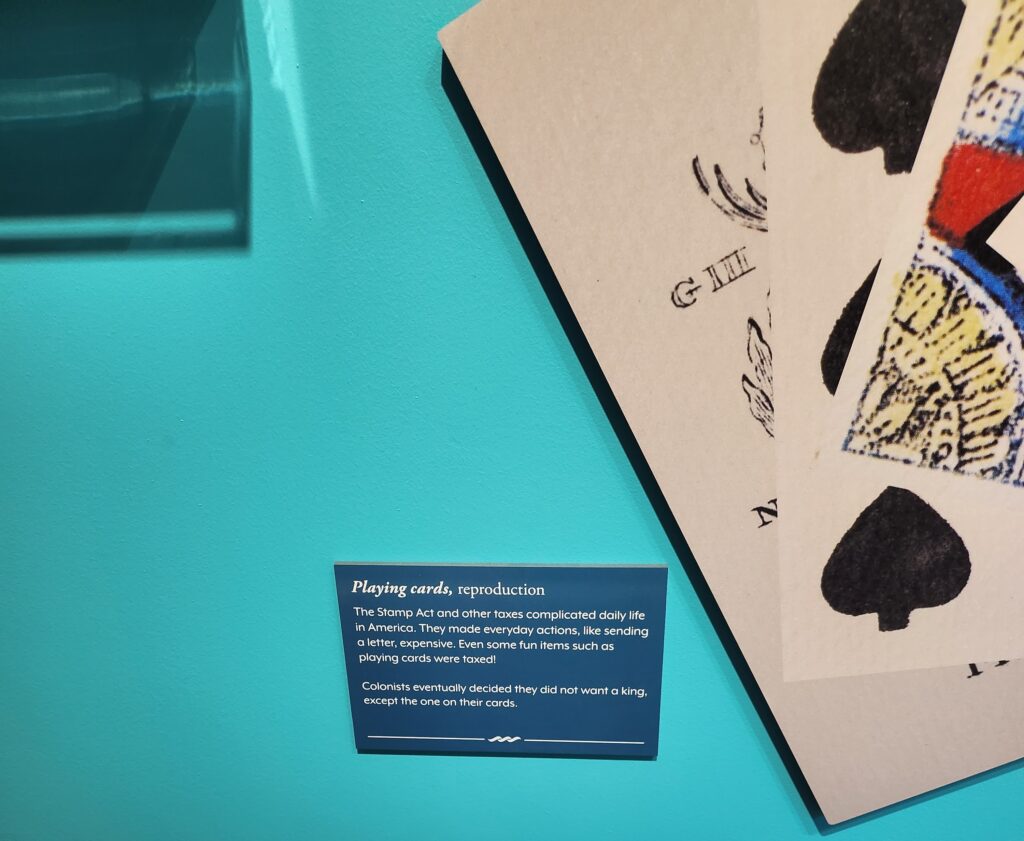
The artifacts throughout are generally well explained and how they relate to each other and the message. One display on the Stamp Act and non-importation agreements had a replica of the “No Stamp Act” teapot (the original is on display at the Art Museums at Colonial Williamsburg) paired with a group of items that would have been subject to non-importation. This tied in with the house tour, as one of the collection was a reproduction of the wallpaper in the public room of the house. The museum centered on Mason as a founding father, the house introduced him as a family man and an important man in the area.
Playing cards with label from the Stamp Act exhibit, Museum at Gunston Hall. Both an excellent example of items the Stamp Act would effect as well as a good sense of humor.
Timed tours of the house start at the visitor center and a guide leads visitors down the drive flanked by rows of cherry trees, not the originals, but lead to an introduction to the house and grounds as examples of Mason’s emphasis and the style of the time for symmetry and order. The house tour started in the main hall with an overview of the layout and architecture. THe guide usually brought groups through the public spaces, leading to the private, but was flexible enough that when part of the group ventured to the private rooms first, she pivoted to those spaces and adjusted the narrative. The house tour focused on the Masons as a family and how the house signaled their wealth and status, from the discussion of the jade green paint in the private rooms to the oriental carvings and chinoiserie in the public dining room. The explanation of why the paint color was important (it was an expensive hue at the time) and the classical themes in the carvings demonstrating education and refinement kept the group interested and asking questions. The tour worked well letting the guests decide the direction; the usual flow would have been a little more effective as it led to the family quarters on the second floor, accessed by either the grand staircase or the very small, very tight servants staircase spiraling up.
In historic houses, especially ones that are thought to be mostly original, rarely are visitors encouraged to touch objects. At Gunston Hall, the site had activities set up in the house, and one of the adjacent buildings, to allow visitors to explore spices through scratch and sniff cards by a spice chest, read letters or do a jigsaw puzzle in Mason’s office, and pick up and study a tea service. In the laundry, one of the open outbuildings, visitors were encouraged to look at the items for the laundress and feel the different textures and quality of pieces representing a Mason daughter, her governess and an enslaved woman.
According to the guide, Gunston Hall was home to at least several dozen enslaved persons. The house was built at least in part through slave labor – the museum includes a brick with a fingerprint – and the elaborate carving was done by an indentured man from England. He is recognized throughout the museum and tour, allowing a discussion of what it meant to be enslaved vice indentured. The contradiction of the rhetoric of the founding fathers and the economic reality of slavery is neither highlighted nor avoided. The tea set activity, for example, includes a note that it would have been washed by an enslaved servant, with dire consequences for breakage. The challenge for the site is how little is known about the Gunston Hall enslaved in particular, as only thirteen names are known.
Once visitors leave the house they are on their own to explore the garden and outbuildings, complemented by explanatory signs in many places and placards with QR codes to offer information.
Gunston Hall on the Web
Gunston Hall’s website leads with its perspective, with the landing page quoting Mason in the Virginia Declaration of rights and the subtitle on the logo “Home of American Rights.” The site is generally easily navigable for general topics and supported by Metro Nova Creative. Gunston Hall is a public private venture between Virginia and the National Society of the Colonial Dames of America, although they are barely mentioned on the website. Each page accessed has a sidebar with the page’s content and buttons to return to “Guide for Visiting” and “Upcoming Events.”
The site targets education, with each page offering a deeper look at a subject, such as the history of the gardens and current plans and use.Once past the landing page, the site is divided similarly to the physical site with “Learn” and “House & Grounds.” Learn from Home is a drop down and button in two places, “Learn” and under “Parents” in the “Families and Teachers” tab. The Learn section focuses on Mason and the development of the Bill of Rights and includes digital exhibits and lessons for distance learning. The section has great resources from foodways to using primary sources. Activities include recommended ages and instructions, such as making a kite similar to the one staged in Mason’s office and designing a battledore: https://gunstonhall.org/learn/learning-from-home/investigating-primary-sources/colonial-learning-make-your-own-battledore/. The website does include a George Mason University student digital project “The Enslaved Children of George Mason” as part of its section on Mason and Slavery,
The challenging part of the site is that at a high level it is easily navigable, but in some areas it takes a lot of digging to find what you want. On one visit to the website, there was a virtual tour of the house, locating it again for a question was challenging.The most in depth Mason biography was found not under the tab that said George Mason, but rather three dropdown menus into the House & Grounds page.
The website supplements the physical site well. Slight navigation issues aside, Gunston Hall clearly rose to the occasion when most schools pivoted to virtual education by providing a website rich in resources for educators and families to explore Gunston Hall, colonial times and the basis of the Bill of Rights.
I am starting the second class in the series for the Graduate Certificate in Digital Public Humanities, after earning my MA in Applied History at George Mason University in 2021. As a retired Naval officer, the program is a building block for a second career as a digital public historian. When I started that masters program, I envisioned working in a museum or at a historic site, with little understanding of the digital side of public history. It’s been an educational adventure.
I currently work in digital public history, as part of the staff at the Roy Rosenzweig Center for History and New Media. I have just finished work on a project cataloging postal covers and other artifacts relating to the Netherlands in World War II. Working at the RRCHNM, I am fortunate to be in an environment that thinks not only about history, but how to do digital history, producing projects and understanding how the field is evolving.
While working at the center, I applied for the graduate certificate program to build on my skills and build a stronger intellectual foundation in digital history. In both the courses already completed, I specially chose to do projects that stretched me, using Kepler.gl in the first and working on an educational game in the second. I am comfortable with Omeka, so trying something completely different has been useful.
Across years of study, I have only worked on development of teaching lessons or practicals in once class, Thirty years ago at instructor training school. I made transparencies for overhead projectors, so I can safely say that skill is beyond outdated at this point.
My primary interest in teaching and learning environments that involve more informal learning and teaching opportunities. Digital history offers opportunities to enrich physical sites, such as a museum or historic site, as well as enhance curriculum and encourage exploration. In this course I would also like to explore how to effectively make those linkages.
In September, I provided a definition of digital humanities that truly needs revisiting and revising, due to both feedback and questions on the definition and due learning(reconsider word) over the past several months. My original post can be found here: A Definition of Digital Humanities | Online Portfolio (kejacobsen.com) or in the posts listed to the left.
I took a trip down the Google rabbit hole after seeing the term “transdisciplinary” in a definition for digital humanities while rereading Burdick, et. al. I had probably read it as interdisciplinary, the term mostly used in related writing. Transdisciplinary, according to Radakovic, refers to “a research or educational approach that seeks to challenge disciplinary boundaries to create a holistic perspective that provides opportunities to connect across scientific and nonscientific communities1.” Given its roots in computing for the humanities and its expansion into multiple forms of media and digital tools, the idea of a holistic approach resonates with me. Exploring several types of digital humanities over the semester has helped develop a better understanding of the scope of the field. It has still left me with some questions I am still not sure of the answer.
For a definition, Digital Humanities is a collaborative, transdisciplinary field that uses digital tools and methods in research and presentation of studies in the humanities. The humanities can be understood as the study of things humans have created. It can be literature, history, religion, law, linguistics or the arts.2 Based in computing and computer technologies, digital tools offer methods of understanding, exploring, analyzing, sharing and presenting information and research. Digital humanities projects use the same tools to educate and engage audiences, often including the general public. The unanswered question is where is the line between a humanities project presented digitally and a digital humanities project?
In an earlier post, my experience with building a community through shared love of a podcast led to a question on what about podcasts, or crowdsourced projects for that matter, causes that effect. The transdisciplinary nature of those mediums may be the answer, as they add a social element to digital humanities. They can be perceived as establishing a relationship with the user that engages and draws them in. Whatever the audience, the strength of digital humanities is finding new approaches to research, analysis and engagement that grow and change with new technologies, regardless of the age of the subject matter.
‘
N. Radakovic, W. I. O’Byrne, M. Negreiros, T. Hunter-Doniger,, E. Pears, & C. Littlejohn . (2022). Toward Transdisciplinarity: Constructing Meaning Where Disciplines Intersect, Combine, and Shift. Literacy Research: Theory, Method, and Practice, 71(1), 398-417. https://doi.org/10.1177/23813377221113515 ↩︎
Jeffrey R. Wilson, “A New Definition of the Humanities,” Insider Higher Education” October 23, 2023. Online at https://www.insidehighered.com/opinion/views/2023/10/25/new-definition-humanities-opinion ↩︎
In May 1940, the German Army crossed the border into the Netherlands; five days later the small nation capitulated and the Bezetting, or occupation, began. The Arnhem Postal History Project offers a view of everyday life in this period, through postal covers, postcards, correspondence and documents. The collection consists of several thousand items, this study uses the 86 pieces in the Forced Labor group and four from the Operation Market Garden and the Aftermath group. The data set is made up of postmark information (date and location), addressee names and addresses, sender names and addresses, and where the item went through German censors if marked, and the associated latitudes and longitudes. The project uses kepler.gl to map the items as an experiment in mapping and understanding the data set.
Forced Labor
All of the countries occupied by the Germans had seen impressment for labor in factories and on farms, and as the war continued, replacing those conscripted for military service. Laborers were taken from Russia, Poland, France, Belgium, Denmark, Norway and the Netherlands; the numbers included the Jewish citizens of those nations as well, forced to labor in the concentration camp system.
In the immediate aftermath of the invasion and early days of the occupation, Dutch prisoners of war were used to clear rubble and do repair work while awaiting disposition.1 Attempts to recruit volunteers met with limited success, leading to impressment of civilians for labor details, both small and large. Among the ways of increasing manpower was the Opbouwdienst, a program to keep discharged soldiers employed through working on roads and drainage. The program became the Nederlandse Arbeidsdienst (NAD) that offered exemption from being sent to Germany for six months’ service. By the spring of 1942, NAD service was compulsory, with harsh punishment for those who tried to evade it, or avoid being called for service in Germany. 2
Conscripted workers worked in factories, on farms, on the construction of defenses (for example the “West Wall” defensive positions in the Netherlands and Denmark), and public works projects. While some did choose to volunteer for work with the promise of better pay and food, much of the labor did not. The workers suffered poor working conditions and risked injury or death from the Allied bombing campaigns.
The tremendous losses suffered during the Russian campaigns as the war progressed, particularly the loss of 500,000 men at the Battle of Stalingrad, put a strain of German resources. The necessity of raising more troops and replacing lost equipment from that campaign increased the demands from commerce and industry to make up the shortfall in labor. This labor shortage led the German authorities in occupied countries to ramp up efforts to recruit or conscript workers.
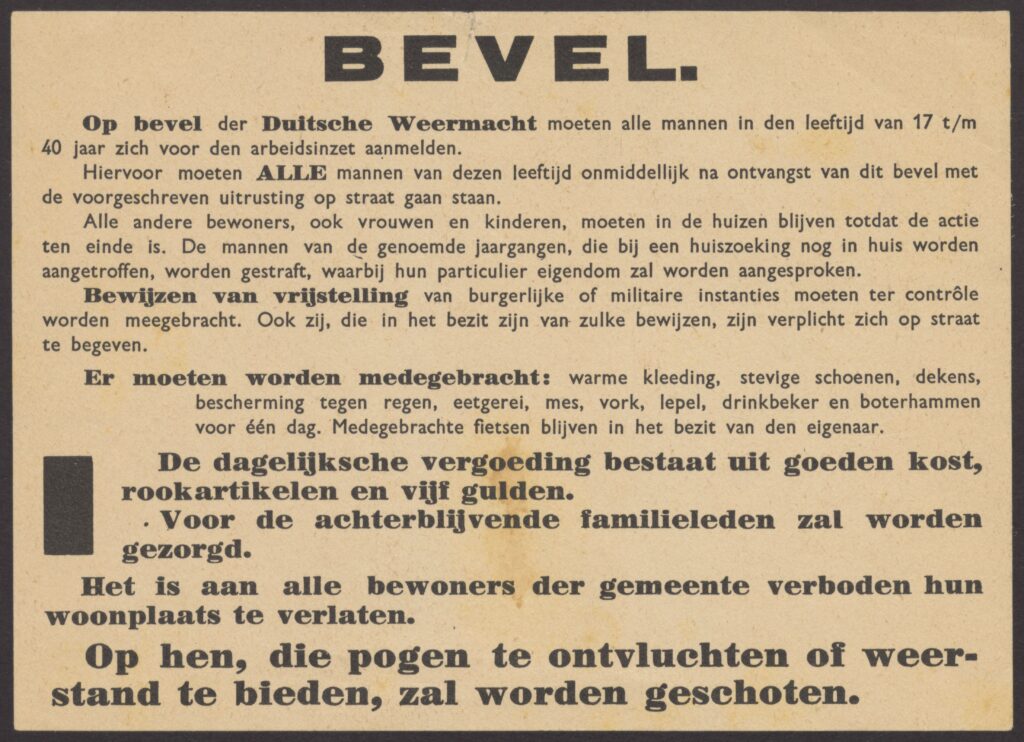
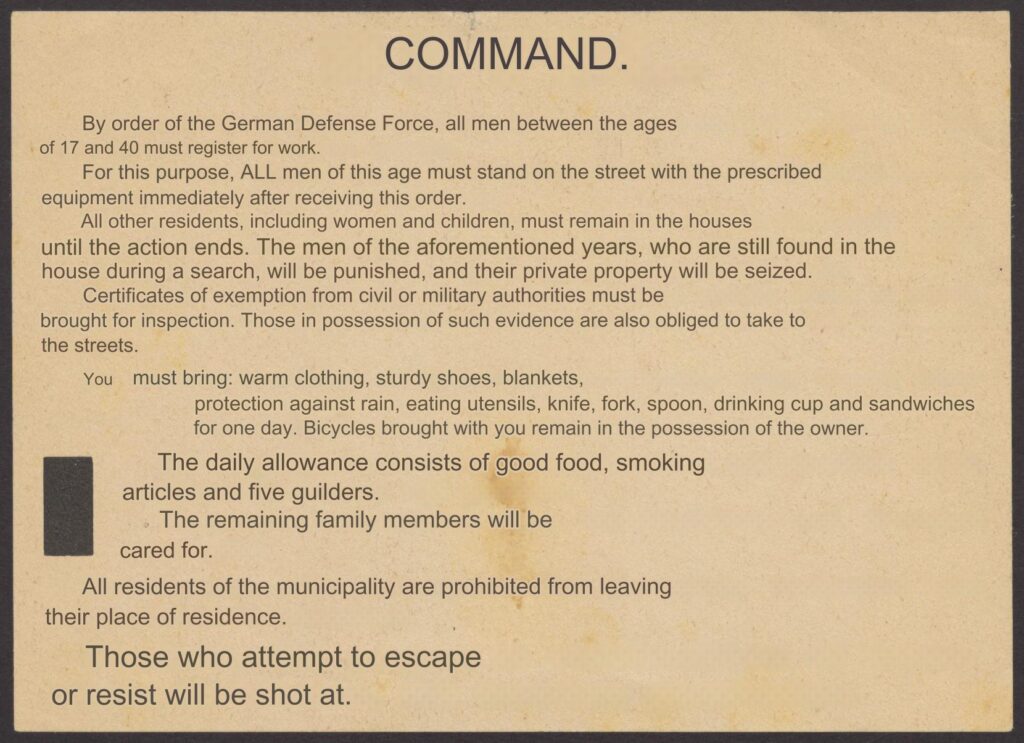
When larger number were needed, German authorities conducted razzia (raid), rounding up men in the streets and at home. Men and women rounded up in the razzias were impressed into labor predominantly in Germany. Men were required to register and report for voluntary work, and when that failed, razzias were used to fill the quotas.
Order delivered in Rotterdam, 9 November, 1944 with translation from Google translate. Arnhem Postal History Collection.
One of most notorious razzias occurred in Rotterdam November 10-11, 1944, which rounded up 52,000 men for service in agriculture and industry in the eastern provinces of the Netherlands and Germany. During “Aktion Rosenstock” all roads and bridges out of Rotterdam and Schiedam were cordoned off, preventing escape from the cities. 3
Correspondence to and from Labor Camps
Using a sample size of 90 items from the Operation Market Garden and Aftermath and Forced Labor (volumes I and II) from the Arnhem Postal History Project, we can get a snapshot of what forced labor looked like to the families and friends of those sent to other location in the Netherlands or Germany for work.
Map 1: Routes taken by correspondence and volume over time
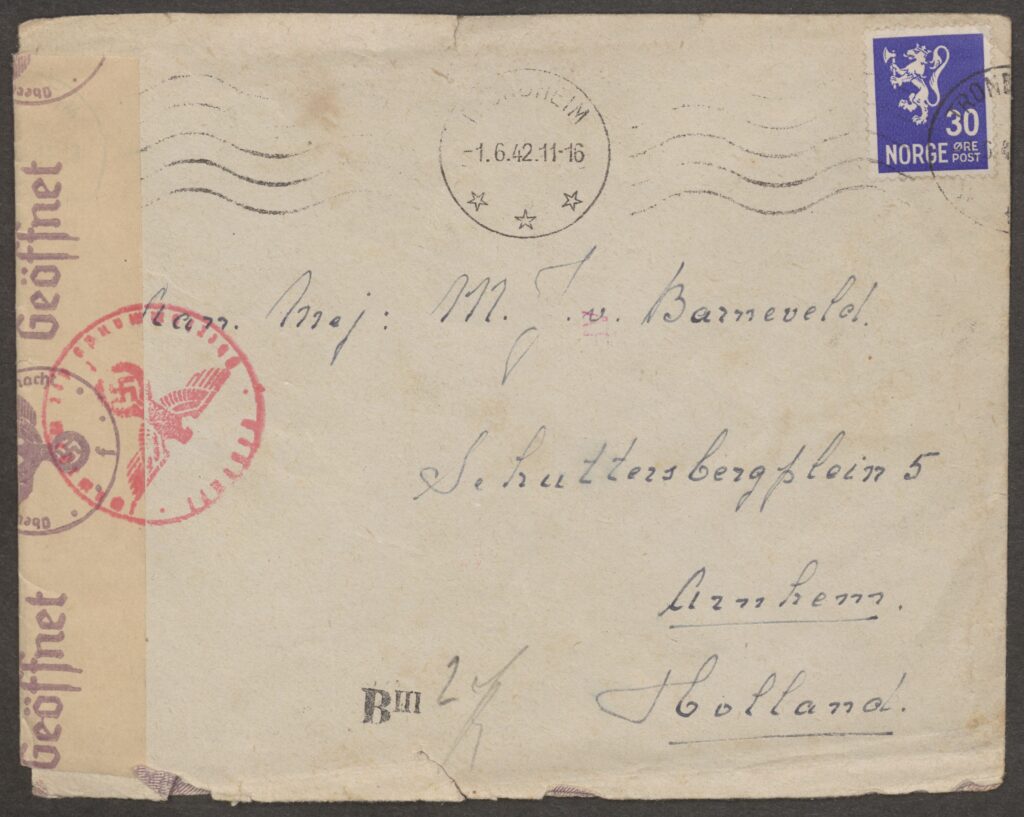
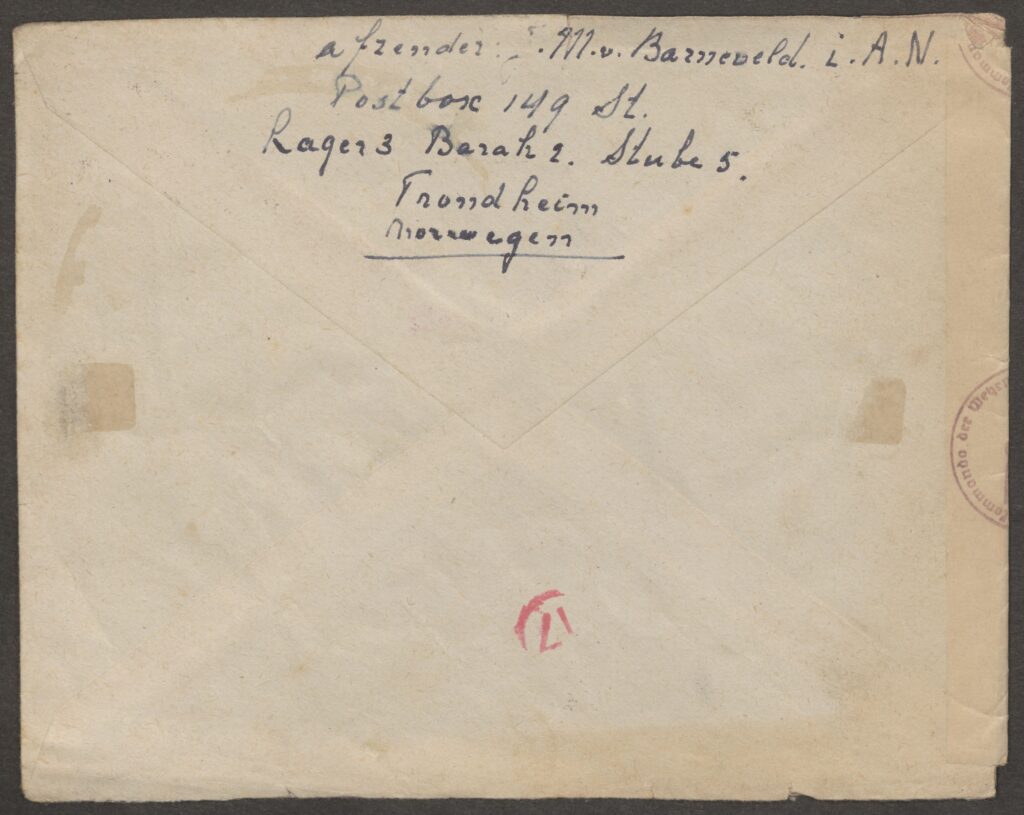
Map 1 is an overview the ninety pieces, this shows the breadth of the forced labor programs, with correspondents not only in the Netherlands, but as far away as Trondheim, Norway. The Trondheim piece is the earliest of the group, unfortunately the letter that accompanied the postal cover was lost.
Envelope from Trondheim to Arnhem. The postmark date is June, 1942. This letter was censored in Hamburg, indicated by the “f” in the stamp.
Map 2: Cluster graph of sender locations
Map 3: Cluster graph of addressee locations
Maps 2 and 3 break out the locations of both the senders and the addressees.
A close examination of the Map 1 will show a some outliers of interest; there are a few arcs connecting labor camps to each other. The correspondence was between J.J. Buurma, forced to work in the Mauser armament factory near Berlin, and J.J. (Hans) Sprey, in the Mauser factory in Oberndorf am Neckar. The second pair was Arie Pot, at a camp near Munich, writing to L. (Bertus) Ruijt in a factory near Köthen.
Map 3: Burma and Pot letters
Censorship
All media and mail in the Netherlands was subject to German regulation and censorship. Most of these items were censored in Cologne, Germany, with the exception on one piece, again the Trondheim cover, censored in Hamburg.
Map 4 below is a visualization of the effect of censorship. The red lines trace the correspondence from the sender to the censor’s location, in these examples either Hamburg or Cologne. The green lines represent the movement from the censor to the destination.
Map 4: Effect of censorship on correspondence pathways
Although several items have additional postmarks that indicate passage through the censors was frequently fairly fast, the omnipresence of the state ensured control of information throughout.
Challenges: Mapping the Data Set in Kepler.gl
Mapping the data set included several challenges related to georeferencing and quantity of data for visualizations.
Georeferencing turned out to be more difficult than anticipated, in part due to many of the addresses being simply a camp name. The visualization still works, mapping to the city or town named on the item, but for granularity it would be a problem. Georeferencing in both Excel and Google docs required add ins, I used a free script from GitHub and created the extension in my Google doc.
The sample size of the data set created two challenges. Setting up the kepler.gl filter for the timeline had a steep learning curve, as my first several tries failed. Working through the problem, I had to shift to month/year instead of month/day/year. The second challenge of the data set was that the bulk of the collection was related to four separate groups of people, accounting for 59 of the 90 items and lines. The effect of this was fewer distinct lines of travel for the items.
Person 1
Person 2
Forced Labor Assignment
No. Items
Louis Bernaards
Marie Pilings/Andrea Bernaards
Worker in Mauser factories
14
T.J. Verseveldt
Gezina Cornelia Sjouke
Worker at BMW airplane engine plant
19
Hendrik van der Zee
J. and A.J. van der Zee
Worker in Mauser factories
22
Dik den Otter
E. den Otter
Razzia after Operation Market Garden
4
Figure 1: Correspondence pairs and where forced labor occurred used for Map 5.
Map 5: Correspondence paths filtered by largest groups of correspondents
Conclusion
The Arnhem Postal History Project collection offers insight into both the postal history and the social history of the Netherlands. The Forced Labor group, although a small sample size, demonstrates the effect of German labor policy in occupied countries, sending men to factories in German, usually involuntarily. Censorship created delays in mail delivery, adding to the challenges of separation.
Kepler.gl was an effective tool to visualize the data. The size of the data set limited what conclusions could be drawn, but the maps did provide a good snapshot. The layers and filters allowed different views of the information to help develop further lines of research, such as a drill down on the correspondence between men in labor camps writing each other. Overall, kepler.gl worked well to map the correspondence and is a useful tool for digital humanities projects.
Paul Glaser, Dancing with the Enemy: My Family’s Holocaust Secret, 38–41. ↩︎
Kees Adema and Jeffrey Groeneveld, , The Paper Trail: World War II in Holland and Its Colonies as Seen through Mail and Documents, 277–84. ↩︎
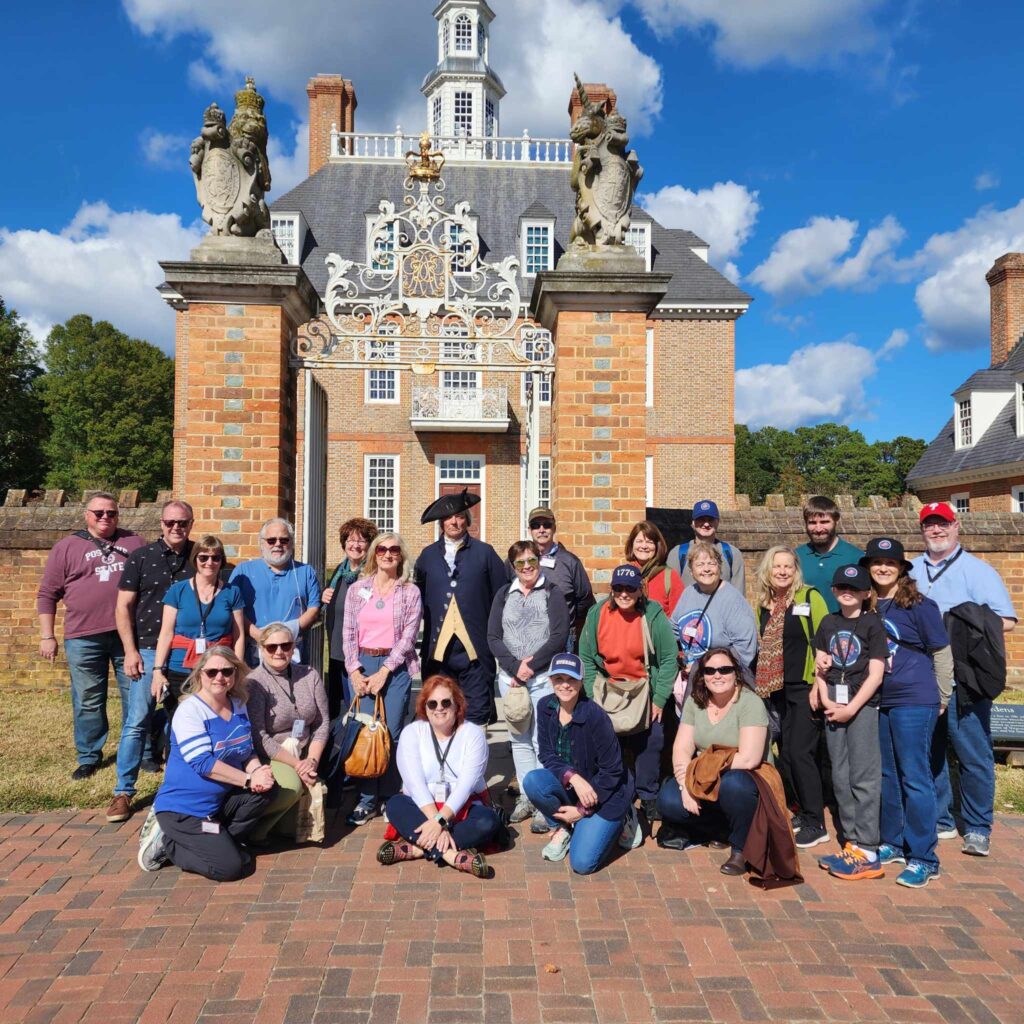
My Zoom book club, a spinoff of the podcast, decided we wanted to do a meet up, in Colonial Williamsburg, to celebrate our group and the podcast that brought us together. After a wonderful weekend, including dinner and a ghost tour with Liz Covart, almost half of us tested positive. We share well, apparently, a weird book and podcast loving COVID cluster.
Ron Carrington as President George Washington with members of Poor Richard’s Book Club, 23 April 2023.
Podcasts allow humanities scholars to engage with the public differently as a medium as they have an ability to reach wide audiences that may not traditionally interact with the digital humanities. In this picture are a music teacher and a professor who teaches teachers, a Canadian farmer and his wife, two lawyers, a family counselor, a nurse, and the Australian contingent, a healthcare advocate, a surveyor, and their son (Ii’m the one kneeling second from the left). A group brought together by a mutual interest in history and a podcast that not only made several people want to read the book discussed, but read it with other people. Podcasting offers an opportunity for humanities scholars to explore and are of their interest and research in way that can be both entertaining and educational. I was introduced to both Ben Franklin’s World and Revolutions as assignments in class. Through another non-scholarly podcast, I started listening to Dressed with fashion historians. And through The Green Tunnel I am learning about the Appalachian Trail even though I despise camping and anything more than and easy day hike.
Podcasts can be an introduction to the humanities, and reach a wide audience due to their accessibility. They allow a digital scholar to present their research or scholarship in a format that anyone can access and they can explore and share areas of interest in smaller, more digestible bites for a public audience. The medium of podcasting allows a more personal connection and engagement with the audience than most others in the digital humanities.
The popularity, reach and the less academic sound of podcasts should not be mistaken for less rigor. Podcasts are as much a tool as the others used in the digital humanities. Like the mapping and visualization tools, it requires its own set of data and research. The product may not be a graphic; it is still a synthesis of data and research. The script writing aspect requires the use databases and search tools as wells as an understanding of permitted use and copyright law. The addition of show notes to most podcasts can tie them further to related tools, as they may be part of a larger humanities project and make use of the other tools to supplement the discussion.
Podcasts are a versatile tool for the humanities scholar, as it can generate interest in a topic or bring in a new audience. They provide the public an opportunity to learn and explore something new and different and can open a door to learning more and exploring other interests. Their availability on the same platforms that most people are listening to music on opens up the potential audience for the podcast and potentially other projects.
And we are all recovered and reading Alan Taylors’s The Civil War of 1812: American Citizens, British Subjects, Irish Rebels, & Indian Allies.
Digital Humanities issues, tools, and resources
Warning: Attempt to read property "comment_ID" on null in /home/kejacobs/public_html/wp-content/plugins/subscribe-to-comments/subscribe-to-comments.php on line 72
Warning: Attempt to read property "comment_author_email" on null in /home/kejacobs/public_html/wp-content/plugins/subscribe-to-comments/subscribe-to-comments.php on line 592
Warning: Attempt to read property "comment_post_ID" on null in /home/kejacobs/public_html/wp-content/plugins/subscribe-to-comments/subscribe-to-comments.php on line 593