Category Archives: Guides

(Re)Defining Digital Humanities

In September, I provided a definition of digital humanities that truly needs revisiting and revising, due to both feedback and questions on the definition and due learning(reconsider word) over the past several months. My original post can be found here: A Definition of Digital Humanities | Online Portfolio (kejacobsen.com) or in the posts listed to the left.

I took a trip down the Google rabbit hole after seeing the term “transdisciplinary” in a definition for digital humanities while rereading Burdick, et. al. I had probably read it as interdisciplinary, the term mostly used in related writing. Transdisciplinary, according to Radakovic, refers to “a research or educational approach that seeks to challenge disciplinary boundaries to create a holistic perspective that provides opportunities to connect across scientific and nonscientific communities1.” Given its roots in computing for the humanities and its expansion into multiple forms of media and digital tools, the idea of a holistic approach resonates with me. Exploring several types of digital humanities over the semester has helped develop a better understanding of the scope of the field. It has still left me with some questions I am still not sure of the answer.

For a definition, Digital Humanities is a collaborative, transdisciplinary field that uses digital tools and methods in research and presentation of studies in the humanities. The humanities can be understood as the study of things humans have created. It can be literature, history, religion, law, linguistics or the arts.2 Based in computing and computer technologies, digital tools offer methods of understanding, exploring, analyzing, sharing and presenting information and research. Digital humanities projects use the same tools to educate and engage audiences, often including the general public. The unanswered question is where is the line between a humanities project presented digitally and a digital humanities project? 

In an earlier post, my experience with building a community through shared love of a podcast led to a question on what about podcasts, or crowdsourced projects for that matter, causes that effect. The transdisciplinary nature of those mediums may be the answer, as they add a social element to digital humanities. They can be perceived as establishing a relationship with the user that engages and draws them in. Whatever the audience, the strength of digital humanities is finding new approaches to research, analysis and engagement that grow and change with new technologies, regardless of the age of the subject matter.

  1. N. Radakovic, W. I. O’Byrne, M. Negreiros, T. Hunter-Doniger,, E. Pears, & C. Littlejohn . (2022). Toward Transdisciplinarity: Constructing Meaning Where Disciplines Intersect, Combine, and Shift. Literacy Research: Theory, Method, and Practice, 71(1), 398-417. https://doi.org/10.1177/23813377221113515
    ↩︎
  2. Jeffrey R. Wilson, “A New Definition of the Humanities,” Insider Higher Education” October 23, 2023. Online at https://www.insidehighered.com/opinion/views/2023/10/25/new-definition-humanities-opinion ↩︎

Crowdsourcing

WIkipedia’s reputation has improved from its inception, a site with the radical idea that non-experts should be able to contribute to knowledge on the world wide web. Not long ago, I would not consider Wikipedia a valid resource, but while I would not use it as a main source, I have found it is often a jumping off point for research. Understanding how Wikipedia entries is important in evaluating the value of an article and its accuracy. Given that chat bots also use it as one of their large language models, the ability to review entries and how they develop is useful.

Using the Digital Humanities page as an example, the “Talk” and “View history” sections provide insight into the development of the page and its contents. “View history” allows the viewer to see how the site has changed, as well as a side by side comparison of what each change did to the site. It also identifies the editor, linking to their user page and frequently a description of their expertise. 

Digital humanities: Revision history at https://en.wikipedia.org/w/index.php?title=Digital_humanities&action=history

In the screenshot above, examples include a 27 November 2022 edit for unsourced material being added; a 3 June 2022 addition on Analysis of macroscopic trends in cultural change was added, then changed slightly.; and on 5 January 2022 entries reflecting the rendition of the unsourced work with comment, and the subsequent removal of it again. The 27 November 2022 change is made by ElKevbo, the third highest contributor to the site, and/or his biography, works in the digital humanities and higher learning.

Adding to this are comments in the “Talk” section, a discussion of what content should be added. I particularly liked the following post, discussing areas to improve their understanding and that of other users:

Technology, criticisms, & future at https://en.wikipedia.org/wiki/Talk:Digital_humanities

The section also discusses some of the editing decisions and collaboration, such as an early crowdsourcing event at THATcamp (The Humanities and Technology Camp) in Australia making several edits. The first large batch of edits were made by the in the field thinking and learning about the digital humanities.

Understanding the source of the information, and that Wikipedia editors are trying to maintain community standards, lends credibility to the entries. AI crowdsources information through the text it was trained on, including Wikipedia. While it synthesizes information rapidly, and by using large, internet based data files, it is still only as good as the crowd it is using. Its inability to show sources makes it another useful starting point, but not necessarily an ending point. I queried Chat GPT about its use of Wikipedia, with this response:

I don’t have direct access to the internet or specific databases like Wikipedia in real-time. Instead, I’ve been trained on a diverse range of internet text available up until my last update in 2022, which includes information from sources like Wikipedia. My responses are generated based on patterns and information learned from that data.

If you ask me a question about a topic, I’ll generate a response based on the knowledge I’ve acquired during my training. So, while I can’t access Wikipedia directly, I’ve learned from its content and can provide information based on what I’ve previously read and absorbed.

Wikipedia, a world of words askew,
A dance of data, a linguistic brew.
No capital chains to bind its grace,
In ee cummings’ style, it finds its place.

A symphony of facts in a tangled rhyme,
Hyperlinks weaving through the sands of time.
No rigid structure, just free-flowing streams,
In Wikipedia’s garden, knowledge dreams.

Lowercase whispers tell tales untold,
As wikis unfold, in pixels bold.
Syntax surrenders, conventions flee,
In this textual playground, wild and free.

Beneath the letters, a universe blooms,
A kaleidoscope of knowledge looms.
No need for order, no need for rule,
Wikipedia dances in the vastness, cool.

A symphony of voices, a chorus untamed,
In cummings’ spirit, where no word’s framed.
Wikipedia, a poem of pixels and links,
In the language of chaos, information syncs.

wiki leaks words, a
cacophony, a
melange of info
sprawling unchained un
bridled in its verve un
stop-pable unwavering it grows

words dance in links
a tap dance of thoughts
meandering through time space
no capitals or spaces
just the pulse of info
in a torrential race

oh, wikipedia!
encyclopedic cacophony
where knowledge meets chaos
in a glorious blend
of facts and conjecture
yet a haven for seekers
in a digital splendor un
matched and profound

The poems above illustrate both the questionable and good about AI crowdsourcing. The Chat GPT prompt was “write a poem in the style of ee cummings.”The first try has the syntax and rhythm of Cummings, but it was not until the second try that it picked up the trait Cummings is known for, the lack of capitalization. AI did not recognize initially, although the Wikipedia entry on Cummings describes it, with several examples of poems.

The challenge of crowdsourcing, through a Wikipedia or Wikipedia of the future or AI, remains the expertise and the biases of the crowd. Lockett engagement with her students at Spelman as being motivated by realizing how many gaps in information existed about their college and those like it, and Black women in particular1. Crowdsourcing brings a myriad of experiences, expertise and interests to the world in a very shareable way, however moving into the future, identifying the gaps and blind spots will be critical to their overall effectiveness as a tools.

  1. Lockett, Alexandria. “Why Do I Have Authority to Edit the Page? The Politics of User Agency and Participation on Wikipedia.” In Wikipedia @ 20: Stories of an Incomplete Revolution. Edited by Joseph Reagle and Jackie Koerner (MIT Press,
    2020), https://doi.org/10.7551/mitpress/12366.003.0019Links to an external site.., p 213. ↩︎

Why Metadata Matters

Metadata, in simplest terms is the data about data. Metadata provides a description of a Web resource by assigning attributes to the object. www.dublincore.org uses the example of how libraries use metadata as part of the catalog: title, author, date of creation or publication, etc.  The site goes on to explain that part of the stressful information overload frequently experienced during a search is undifferentiated digital data. 

A Web resource’s basic information follows the basic idea of the library catalog, expanding it out to encompass more information. The Dublin Core Standards offer a framework for elements using terms that were developed across multiple user communities as a means of simplifying metadata.

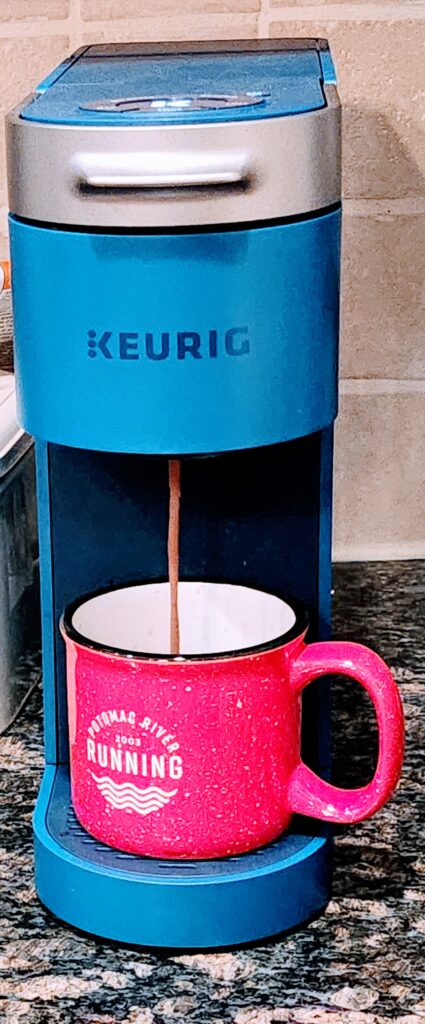
Metadata attached to a photograph of a coffeemaker adds information for perspective. By offering information on the physical dimensions, it helps visualized the item outside of the flattened digital format.

Guide to Digitization

In Art History, many years ago, I was shown Dali’s Persistence of Memory. It covered the screen in the auditorium, and I have seen it on posters and t-shirts for years since.  It was the ‘80s, so the image was a projection of a slide from a photograph, but one elements applies to thinking about digitization.  The painting, it turns out, is not a large grandiose work. At the Museum of Modern Art in New York, a viewer will discover Dali’s work is 9.5 inches by 13 inches, making it only a little larger than a sheet of paper.

Salvador Dalí. The Persistence of Memory. 1931 | MoMA

The virtual and reality of the Dali painting demonstrates some of the thought processes required when determining what to digitize and how.   Digitization allows the painting to be seen and studied regardless of location, but it both enhances (allows closer looks at the elements of the piece) and detracts (distorts the size and detail of the physical work) from the object itself.  Digitizing an object is a balance between which properties are transmittable and which are not.   Scale and texture are harder to capture digitally. Most of all, context and bias are impossible to capture. When culturally sensitive objects are being considered for digitization, the potential harm and the bias of the organization digitizing the object have to be weighed against the value of digitizing an object and the purpose of making a digital image.

Conway’s discussion of manipulation of images for different effects was an interesting discussion of the value of an exact copy and what can be done to make a digital image either more useful or more faithful to the original creator.  For example, the tone adjustment case he used allowed the viewer to see into the home and understand more about the family and its living conditions than the original print.

Video and 3D imaging allows digitization with more perspective. Combining 3D imaging with 3D printing, museums can offer visitors with sensory or vision issues and option to have 3D models of objects to touch and understanding.

The ability to digitize objects allows a wider variety of uses than an object solely in situ. It has the potential to widen the reach of an object, as well as manipulation to develop a better understanding of the object its place in time and space.