Ben Franklin’s World’s gave me COVID.
My Zoom book club, a spinoff of the podcast, decided we wanted to do a meet up, in Colonial Williamsburg, to celebrate our group and the podcast that brought us together. After a wonderful weekend, including dinner and a ghost tour with Liz Covart, almost half of us tested positive. We share well, apparently, a weird book and podcast loving COVID cluster.
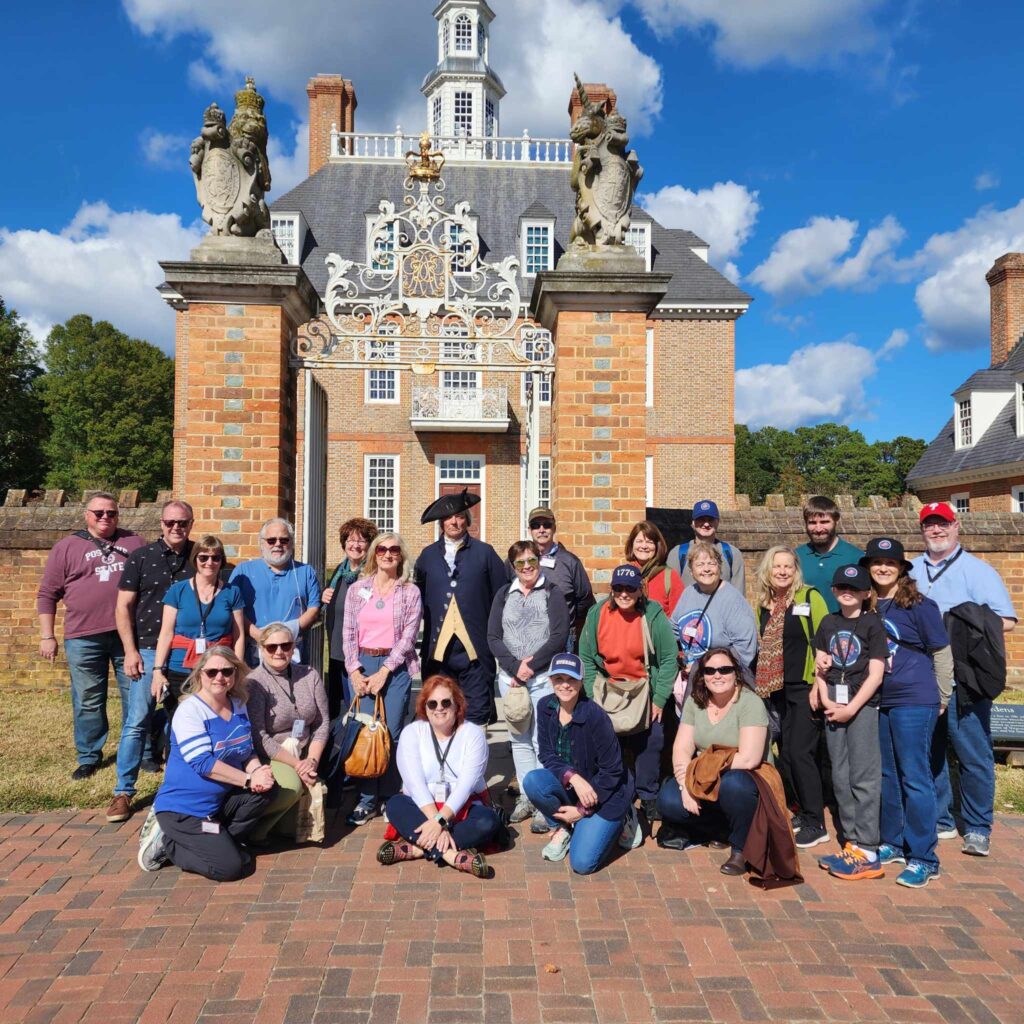
Podcasts allow humanities scholars to engage with the public differently as a medium as they have an ability to reach wide audiences that may not traditionally interact with the digital humanities. In this picture are a music teacher and a professor who teaches teachers, a Canadian farmer and his wife, two lawyers, a family counselor, a nurse, and the Australian contingent, a healthcare advocate, a surveyor, and their son (Ii’m the one kneeling second from the left). A group brought together by a mutual interest in history and a podcast that not only made several people want to read the book discussed, but read it with other people. Podcasting offers an opportunity for humanities scholars to explore and are of their interest and research in way that can be both entertaining and educational. I was introduced to both Ben Franklin’s World and Revolutions as assignments in class. Through another non-scholarly podcast, I started listening to Dressed with fashion historians. And through The Green Tunnel I am learning about the Appalachian Trail even though I despise camping and anything more than and easy day hike.
Podcasts can be an introduction to the humanities, and reach a wide audience due to their accessibility. They allow a digital scholar to present their research or scholarship in a format that anyone can access and they can explore and share areas of interest in smaller, more digestible bites for a public audience. The medium of podcasting allows a more personal connection and engagement with the audience than most others in the digital humanities.
The popularity, reach and the less academic sound of podcasts should not be mistaken for less rigor. Podcasts are as much a tool as the others used in the digital humanities. Like the mapping and visualization tools, it requires its own set of data and research. The product may not be a graphic; it is still a synthesis of data and research. The script writing aspect requires the use databases and search tools as wells as an understanding of permitted use and copyright law. The addition of show notes to most podcasts can tie them further to related tools, as they may be part of a larger humanities project and make use of the other tools to supplement the discussion.
Podcasts are a versatile tool for the humanities scholar, as it can generate interest in a topic or bring in a new audience. They provide the public an opportunity to learn and explore something new and different and can open a door to learning more and exploring other interests. Their availability on the same platforms that most people are listening to music on opens up the potential audience for the podcast and potentially other projects.
And we are all recovered and reading Alan Taylors’s The Civil War of 1812: American Citizens, British Subjects, Irish Rebels, & Indian Allies.
