George Mason’s Gunston Hall: Home of American Rights, https://gunstonhall.org. Visited January and February 2024.
George Mason IV built Gunston Hall between 1754 and 1758, near the Potomac River on one of the properties he inherited from his father. The Mason family was an important one in the Chesapeake Bay area, with properties in Virginian, Maryland and the area of Virginia that would become West Virginia. While Mason is less famous today than his neighbor at Mount Vernon, both the physical and digital sites for Gunston Hall seek to emphasize his contributions as a founding father in his own right.
On the Banks of the Potomac: George Mason’s Gunston Hall.
Situated in present day Lorton, Virginia, the road to the house sets the stage for discussing the house and grounds, as the drive leading to the visitor center showcases the allee of cherry tr ees framing and drawing the eye to the house. The grounds are open to walk around, hike and picnic, but the house itself is only open with a guide. The site is designed for the visitor center to introduce the visitor to Mason, his times, beliefs and accomplishments and exhibits that tie them to more recent events.
The overarching story is George Mason as an author of the Virginia Declaration of Rights and a leading proponent of the principles in the Bill of Rights – the tour guide was quick to assert Mason wrote them, Madison pushed them through. The physical space in the visitor center leads the visitor into a museum through exhibits on the era, with artifacts ranging from tea boxes and rifles to copies of indenture agreements and furniture. Thought was clearly given to encouraging interaction with the space and ideas, with hands on activities in the visitor center including using stones and scales to vote on term limits in the Senate and a desk with pamphlets and letters to Mason that guests are invited to pick up and bring to the corner that is a replica of Williamsburg’s Raleigh Tavern to read and discuss.
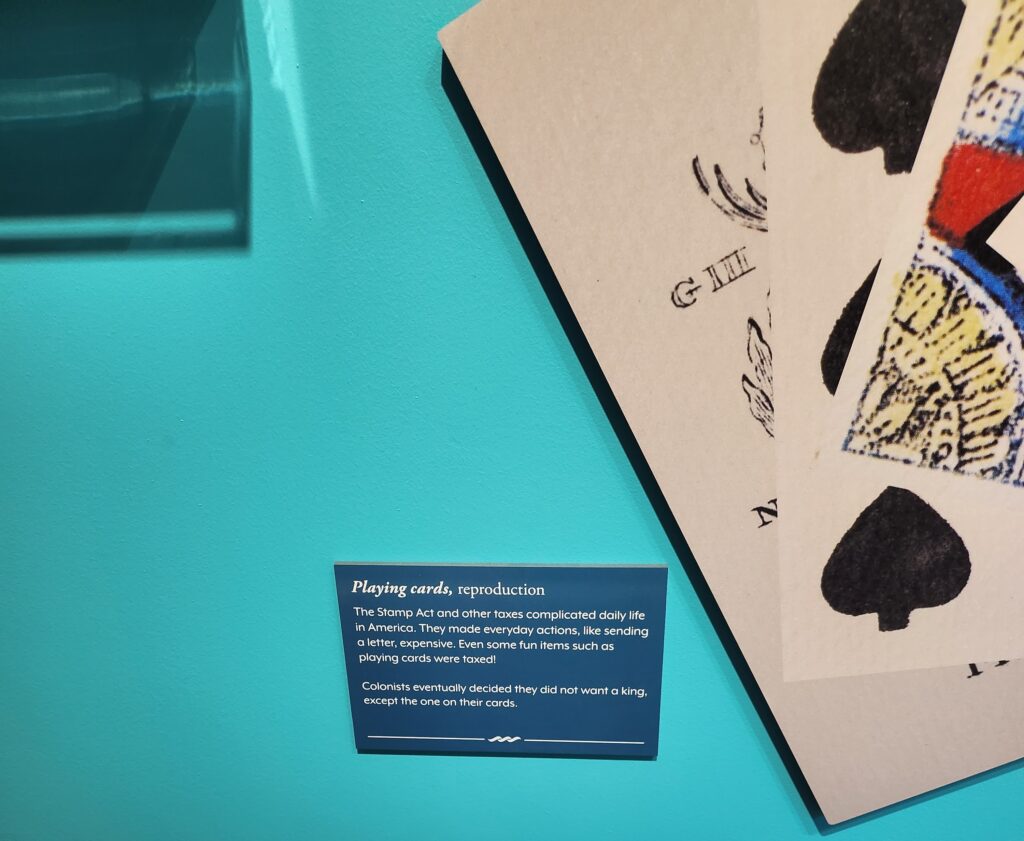
The artifacts throughout are generally well explained and how they relate to each other and the message. One display on the Stamp Act and non-importation agreements had a replica of the “No Stamp Act” teapot (the original is on display at the Art Museums at Colonial Williamsburg) paired with a group of items that would have been subject to non-importation. This tied in with the house tour, as one of the collection was a reproduction of the wallpaper in the public room of the house. The museum centered on Mason as a founding father, the house introduced him as a family man and an important man in the area.
Timed tours of the house start at the visitor center and a guide leads visitors down the drive flanked by rows of cherry trees, not the originals, but lead to an introduction to the house and grounds as examples of Mason’s emphasis and the style of the time for symmetry and order. The house tour started in the main hall with an overview of the layout and architecture. THe guide usually brought groups through the public spaces, leading to the private, but was flexible enough that when part of the group ventured to the private rooms first, she pivoted to those spaces and adjusted the narrative. The house tour focused on the Masons as a family and how the house signaled their wealth and status, from the discussion of the jade green paint in the private rooms to the oriental carvings and chinoiserie in the public dining room. The explanation of why the paint color was important (it was an expensive hue at the time) and the classical themes in the carvings demonstrating education and refinement kept the group interested and asking questions. The tour worked well letting the guests decide the direction; the usual flow would have been a little more effective as it led to the family quarters on the second floor, accessed by either the grand staircase or the very small, very tight servants staircase spiraling up.
In historic houses, especially ones that are thought to be mostly original, rarely are visitors encouraged to touch objects. At Gunston Hall, the site had activities set up in the house, and one of the adjacent buildings, to allow visitors to explore spices through scratch and sniff cards by a spice chest, read letters or do a jigsaw puzzle in Mason’s office, and pick up and study a tea service. In the laundry, one of the open outbuildings, visitors were encouraged to look at the items for the laundress and feel the different textures and quality of pieces representing a Mason daughter, her governess and an enslaved woman.
According to the guide, Gunston Hall was home to at least several dozen enslaved persons. The house was built at least in part through slave labor – the museum includes a brick with a fingerprint – and the elaborate carving was done by an indentured man from England. He is recognized throughout the museum and tour, allowing a discussion of what it meant to be enslaved vice indentured. The contradiction of the rhetoric of the founding fathers and the economic reality of slavery is neither highlighted nor avoided. The tea set activity, for example, includes a note that it would have been washed by an enslaved servant, with dire consequences for breakage. The challenge for the site is how little is known about the Gunston Hall enslaved in particular, as only thirteen names are known.
Once visitors leave the house they are on their own to explore the garden and outbuildings, complemented by explanatory signs in many places and placards with QR codes to offer information.
Gunston Hall on the Web
Gunston Hall’s website leads with its perspective, with the landing page quoting Mason in the Virginia Declaration of rights and the subtitle on the logo “Home of American Rights.” The site is generally easily navigable for general topics and supported by Metro Nova Creative. Gunston Hall is a public private venture between Virginia and the National Society of the Colonial Dames of America, although they are barely mentioned on the website. Each page accessed has a sidebar with the page’s content and buttons to return to “Guide for Visiting” and “Upcoming Events.”
The site targets education, with each page offering a deeper look at a subject, such as the history of the gardens and current plans and use.Once past the landing page, the site is divided similarly to the physical site with “Learn” and “House & Grounds.” Learn from Home is a drop down and button in two places, “Learn” and under “Parents” in the “Families and Teachers” tab. The Learn section focuses on Mason and the development of the Bill of Rights and includes digital exhibits and lessons for distance learning. The section has great resources from foodways to using primary sources. Activities include recommended ages and instructions, such as making a kite similar to the one staged in Mason’s office and designing a battledore: https://gunstonhall.org/learn/learning-from-home/investigating-primary-sources/colonial-learning-make-your-own-battledore/. The website does include a George Mason University student digital project “The Enslaved Children of George Mason” as part of its section on Mason and Slavery,
The challenging part of the site is that at a high level it is easily navigable, but in some areas it takes a lot of digging to find what you want. On one visit to the website, there was a virtual tour of the house, locating it again for a question was challenging.The most in depth Mason biography was found not under the tab that said George Mason, but rather three dropdown menus into the House & Grounds page.
The website supplements the physical site well. Slight navigation issues aside, Gunston Hall clearly rose to the occasion when most schools pivoted to virtual education by providing a website rich in resources for educators and families to explore Gunston Hall, colonial times and the basis of the Bill of Rights.
