Category Archives: Uncategorized

Blog post 8, Unmapped Horizons

The last post was tinged with gloom about the public humanities with the picture getting gloomier in the ensuing days. Even so, spending the last two semesters engaged with the Smithsonian Institution provided me with perspective on the behind the scenes life of an iconic organization.  As we worked through the “Meet Me at Mi Museo” piece, I learned about the history of the Smithsonian and its realization that as an organization it needed a better understanding of the Latino population it employed and how Latino history, arts and culture were (or were not) present in the museums. And in these challenging times, having an e-mail address with the Smithsonian, receiving the mail with leadership’s guidance and strategic vision also gave me an unexpected glimpse into how they are crafting a response to all the outside pressures. 

Over the past few weeks the struggle with mapping continued, with ArcGIS layers built for the “tour of salsa” stops and a map of 2025 salsa festivals to illustrate the worldwide reach of the music and dance. The vision of mapping locations in song defaulted to mapping the performer’s birthplaces, to demonstrate to unexpected sources of  music and inspiration. As I continued to pull on string, the secondary music challenge became the lack material, as much of it was in draft or incomplete for the upcoming exhibit. As a result, instead of a fully blown story in story maps, I have developed a framework that can be fleshed out as content in determined. I have also developed a quick guide to help them access and work with the content in the Smithsonian’s ArcGIS hub. I am a little disappointed to not get it over the finish line, but I do think it is in a useful place.

After this internship I am better educated about museum beginnings and hybrid museum models. I have taken classes about exhibit development and experience, but rarely seeing how museums come into existence. We all see events such as the opening of the National Museum of the American Indian or the National Museum of African-American History and Culture (NMAAHC), but short of reading Dr. Bunch’s book about bringing the latter to life, we rarely get to see how they begin. I reviewed legislation, committee reports, the report on how the Latino story was ignored and underrepresented and was able to see the positive initiatives to overcome the bias. The research into museum websites was really interesting, with all the different public faces they chose.

After this internship, I hope that I am a better public historian moving forward.
Internship Blog 7, or There are no words…

Heading into the homestretch of my time as a Smithsonian intern, I am inundated with what we called “big feelings” in talking to our children. As a historian and currently working as part of the Smithsonian, I am bereft at the Executive Order that was signed out recently. My experience has transformed from learning how the public humanities work institutionally to wondering what constraints may be placed on our work in the near future. Interning at one of the museums called out and threatened with funding cuts in the past, the world looks a bit bleak. 

 Most of my adult life has been sent in increasing levels of leadership. and I am nothing short of impressed by the incredible professionalism shown by the Digital Initiatives team I am working with. In spite of the uncertainty faced by the federal workforce and the Foundation funded staff of the Smithsonian, they continue to move forward with their work and the organization’s vision for NMAL. Everyone at my internship shares a clear vision of where the museum’s digital presence should go in the future. I am sure there is churn behind the scenes, however the kindness and guidance I have been shown, especially as we balanced the projects assigned, the ever worsening news cycle and a family health crisis I had to take care of, has been far greater than I could have expected. I think the next two years, at least, will be in the balancing act we will all have to do, continuing rigorous scholarship in the federal sphere with the sword of Damocles in the corner of our eyes.

My new questions are how do we preserve the rich complexity of American history, good and bad. The desire to erase certain success stories and whitewash the story of the nation is alarming. Where do we balance national policy and intellectual honesty? And how do we save and preserve the existing projects that may draw negative attention. While I am a digital public historian, I am running up against my own technical limitations in what I can effect.  

The first of the two projects I am working is complete, and by chance we had already reconsidered any language that might appear disparaging to the institution. The second project, developing maps to support the next exhibit, Puro Ritmo, is underway. Similar to the exhibit work, I was tasked with reviewing Smithsonian ArcGis projects and writing them up. It was an abbreviated report this time, recognizing where we are in the semester, but it offered a chance to delve into the ways that the Smithsonian uses mapping. Currently, I am looking at mapping the global origins and reach of salsa as well as thinking about how to use locations in song to build a story. I think that part will not work well, as most of the songs use location in the abstract — its hard to map unnamed places. We will see how it goes.

Internship blog post 4, or tick tock

I just finished edits on a report I have been working on, meant to inform development of an online exhibit. The report covers case studies of a variety of virtual exhibits and the websites of multiple museums, based on a template provided by my internship. I found the template did not completely offer answers to what works and does not work, so I added a literature review on how virtual exhibits should be evaluated — and was surprised how thin the results were in JSTOR — and the NCPH guidelines for writing reviews of digital projects (NCPH Digital History Project Reviews ). Full disclosure, a discussion at my full time job’s weekly staff meeting covered the topic. So a success is using tools in one part of my professional life to influence work for the other.

I have been struggling with two challenges I did not anticipate. I started the semester with a plan for time management of work and internship. But, as the saying goes, no good plan survives first contact with the enemy, in this case, life in general. I allowed myself to get overly distracted by some challenges in my personal life, and fell behind. Paying attention to my personal life is important, I just became a little too laser focused and lost track.

The second challenge I am fighting through is communication with my internship supervisor. We had to reschedule a few weekly meetings, which would have been less impactful if I had asked for more guidance earlier. We have been using the Planner app in Office 365, which is great for tracking due dates, but I have repeatedly run up against not fully understanding what is expected. I asked at the weeklies when I was unsure, but need to improve at communicating questions and asking for clarification in between. I think that I am working on research and writing outside of business hours got too much in my head as not being business hours – sending an e-mail in the evening is all right, as long as the expectation of an answer is not expected quickly.

As I am catching up on hours and work, my goals going further are to get back on track with managing my schedule and get back into the habits of not being afraid to ask a question regardless of the clock.

I will be putting that in action immediately, as I started an assignment for the next part of my project and realized I have no idea of what they are asking for. So that will lead off tomorrow’s weekly update and my mental reset.

Internship Blog Post 3

Teaching an Oldish Dog New Tricks

The fun and challenging part of doing an internship, and a large part of its value, is the opportunity to move from theory to practice. After years of reading about museums and exhibit design, I am working though how a proposal gets developed, with the people who will be considering the value (and as I write up iteration one of my proposal) practicality of the idea. Proposing an exhibition in a classroom is a good thinking exercise, as you know nothing will come of it. The possibility of a potential exhibit is much more stress.

I have been developing a report on websites and exhibits, delving into not just exhibits and collections, but how the museums present themselves and introduce themselves to the online visitor. The first part of the task was filling out an evaluation form from my internship team, and an assignment to look at and evaluate several sites. Over the past month, I have viewed around fifty sites, with fourteen of them in the report I am writing. This part of the assignment falls on old skill sets, reviewing websites against a checklist, albeit a somewhat poorly defined one. I added the criteria for NCPH reviews of digital projects to help frame my thinking.

The second project I anticipate working on after the awareness campaign will be a mapping problem, which I am looking forward to. I have taken classes on ARCGIS, and I an excited about putting it to use in a real study. I am comfortable with software, it’s building the dataset that intrigues me. Students are always given a predefined set, so defining and creating the associated data set will flex my abilities and learning opportunity.

Peas, carrots and a triceratops

By bringing history into the digital world, educators can engage students in different ways than a textbook and introduce historical concepts and ideas without creating the educational equivalent of eating your vegetables. The digital world is rife with opportunities and challenges for history educators. Digital tools allow students to interact with history and historical thinking in a medium they are increasingly comfortable with and expect to use. Conversely, familiarity and high use of the internet can become a distraction and disseminate misinformation. 

https://www.snopes.com/fact-check/theodore-roosevelt-triceratops

The digital world educators and students navigate both allows the imaginative big game prize for Roosevelt and the evaluation of the fake, based on the millennia apart dinosaurs and Roosevelt lived. He would probably have loved to hunt one though, and the faked photograph can also be used to look at Roosevelt as a sport hunter and a conservationist. It is a fanciful example, yet it illustrates the manipulation in the digital world and how to use that manipulation. Continuing with this photograph, here are more ways it can be used as an educational exercise:

  • Review Wikipedia on “Triceratops.” Note when and where it lived. https://en.wikipedia.org/wiki/Triceratops
  • Review Theodore Roosevelt in Wikipedia. https://en.wikipedia.org/wiki/Theodore_Roosevelt
  • Compare another biography of Roosevelt to the Wikipedia page and look for similarities and differences. 
  • Using the Talk and View History buttons, study the origins and changes to the Wikipedia page. What information can they draw from who the editors are?
  • Study the Theodore Roosevelt Hunting Library at the Library of Congress https://guides.loc.gov/theodore-roosevelt-hunting-library/about-the-collection

As educators, understanding the information and presentation of the information available to students creates a space for learning about how to evaluate information and sources. Instead of considering the digital world a place of potential disinformation, it can be used as a place to hone analytical skills and the habit of historical thinking.

Having said that, the digital world carries with it the risk of students learning “bad” history that is hard to dislodge in their developing brains. The ready availability of conspiracy theories and challenges to what history can be taught already bring challenges into the classroom; the digital world can amplify this. Education, and education on history, is difficult in light of the political and cultural wars being fought nationwide. But the digital world also brings the opportunity for educators to teach history and historical thinking in engaging ways.

The History of Teaching History and the Second Piece of the Puzzle

The Washington Post ran an article in September of 2023 about a teacher in South Carolina who was worried. Her decision the previous year to teach Between the World and Me by Ta-Nehisi Coates had landed her in trouble with parents and school officials, even though she had alternate assignments for students who felt uncomfortable reading the book. She planned to teach it again, conceding that it was unnerving to not know whether her students would turn on her or turn her in again.1 While she was teaching AP Language, not history, it does frame one of the challenges of teaching historical thinking. Political and social divisions are creating tension between what and how history is taught at all levels of education.

The history taught in schools, as Linder explains, can be considered as the somewhat official story of the country. The facts and how they are presented make up how the nation tells a coherent story of its past, present and future. In spite of the external pressures, the wide availability of digital resources offers the opportunity for teachers to encourage historical thinking and teaching critical thinking about history. Primary source material and additional resources are more readily available for students to review, understand, evaluate and synthesize. Empathy may be further developed as looking at the people in history and their circumstances, especially through digital projects such as Slave Voyages, which not only provide sources and context, but helps humanize the data. 

Changes in technology have changed not only how educators can teach history, but how they are able to evaluate understanding through methods beside the traditional paper. Digital projects as student products also help develop historical thinking skills. Including digital projects as both sources and products also offer another way to engage students. Events such as Virginia History Day  — Science Fair for History — allow students from elementary age to high school to develop websites, videos and podcast productions to explore subjects that interest them while learning digital skills. The platform for demonstrating understanding may be different, but the basic skills remain the same. 

The Second Piece of the Puzzle

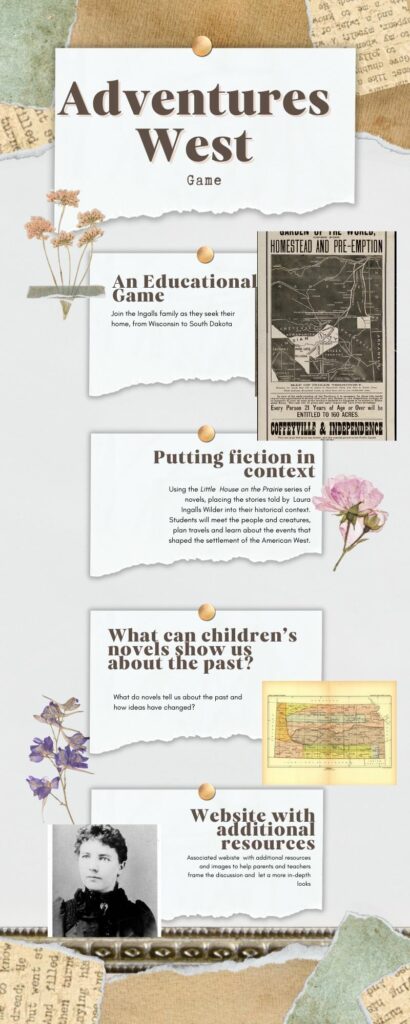
The “Adventures West” project includes both a game and accompanying Omeka site targeted at late middle school and early high school students. The idea is as they work through the game, players evaluate primary and secondary source material about the Laura Ingalls Wilder novels about her family. Links to sources and media drive the storyline forward and require understanding and evaluation of her writings. The Omeka site will include additional resources on the thornier issues raised by Wilder’s writing and the criticism of her writings in recents years.

End of the Journey

Learning how to make a game, even a simple one, was a fun and frustrating experience. When my husband tested it for me last night, I found myself pacing and constantly peeking over his shoulder, building a “can I change that?” list as he went. I couldn’t. I had reached the point where I had to stop – I had two links that just did not work. Fixed them, and then images stopped functioning. Fixed them and called it a day. I am glad I tried something new and well outside my comfort zone. I am also not sure I would do it again. I may do some clean up and experiment with color changes, or build out further (feedback dependent).

The experience was useful, as I had to do the research work, and instead of writing a full paper, had to think through how to present the information for a different audience and where to find balance. The challenge was how to discuss serious issues without making such a sobering game that the target audience would hate it. The balance between heavy subjects, neutral subjects and a little levity requires a fine touch that I am hoping I hit. Honestly, who could let the story of Ma slapping a bear go unrecognized and untold. The next iteration would have to find the same balance, even as it runs into a book the host of the podcast Wilder views as Stephen King on the prairie.

I rolled my eyes at the persona exercise before I started it – it coincided with a work discussion on creating our own personas. I did the readings, interviewed my potential target audience, and knew I was in way over my head and had to really delve into the idea to get this game plan straight. I appreciate having to think that through. I had a thesis advisor at the Command and General Staff College who always hit me with the ‘so what’ and forced me out of reading and writing for myself – I would have been perfectly happy with a project that was for my personal enrichment. LTC Bowie (related distantly to THAT Bowie is I recall) did not let me, and the development of personas ensured I avoided the trap of an overly clever argument that would be useless otherwise.

I am going to send the prototype to the women who helped me, and see what they think and if I hit the mark. More to follow on that.

I would change my podcast pitch though. I still like the idea I pitched to highlight all the great history within an hour’s drive. Another one I toss around mentally would complement this project, rereading historic fiction and breaking it down for parents and teachers.  Does  Johnny Tremaine or Caddy Woodlawn still hold up?  I understand the objections to Wilder’s work, but is it a discussion or a pull it problem – the way she describes what she sees, especially after she also becomes Mary’s eye is truly poetic, but Little House on the Prairie, yikes.

Thank you for sharing this wagon train with me.

Portofolio 3

The box set came in a yellow cardboard box with some of the Garth Williams illustrations printed on it. Inside the box were nine books, with matching yellow covers, that opened the prairie, via the Big Woods, to me. I was a reader, so this gift under the tree felt perfectly chosen for me. Way to go Santa! Millions of other little girls received the same set, but mine was mine. My aunt made me a sunbonnet prairie doll, in three calico patterns, no face but a sunbonnet. And Holly Hobby looked a lot like Charlotte the doll in the books. The sunbonnet is long gone, and the doll is boxed in my basement, but the warm feelings remain. The podcast Wilder calls it the coziness of the books. I took a very informal and non-scientific poll on Facebook: who read the books and did they watch the series. Seconds after I hit “post,” “Yes and yes” and floating heart emojis. People loved the books and series, loved the books and hated the series, and loved the books until they became adults. 

My historical argument is less an argument than an augmentation. The series is beloved by millions, yet millions also feel disappointed in how they feel they are either denigrated or completely missing from her pages. These are valid criticisms, for her portrayal of Native Americans (Indians) is highly problematic, and African-Americans show up one time (Dr. Tan) but then so does Pa performing in blackface. I am trying to look at and offer context to some of Wilder’s stories. Laura is upfront with her family in Indian Territory on the promise of its opening for settlement, but that they are not supposed to be there. That glosses over the larger story of the continued forced removal of Native Americans. 

Adventures West, the game I am trying to build, includes challenging material such as reading the Indian Removal Act and using a website demonstrating the cessions constantly being required of the Native Americans. As an educational game, the learning cannot just be the bad parts, but will include animals encountered and their status in today’s world. 

The first idea had a lot of complex branches, however for simplicity of play, it will be a straight line game with offshoots for quick learning. I am not going to be able to do every topic I would like, I will be trying to do some of the heavy lifting on tough topics and work within primary sources.

Portfolio #2

Last semester, we read about the evolution of the digital humanities from computing humanities through today and the myriad types of projects in the digital public humanities today. In digital public history, willingness to embrace and adapt to change keeps projects vibrant and engaging. Even the venerable Valley of the Shadow has archived its early versions in favor of new, improved version that with improvements in user interfaces to allow for usage on a variety of devices and screen sizes. The updated version recognizes that the audience for digital public history and the preferred means of accessing projects has fundamentally changed. Digital public history projects are taking advantage of advancement in mapping, data and methods of public engagement to adapt and thrive.

Mapping and geolocation have added both increased visualization of space and distance as well as engaging audiences in an immediate and tangible way. Mapping, combined with data analytics, has driven projects that allow better visualization of concepts and ideas. Digital public history projects can also use a combination of mapping and geolocation to develop projects that engage the community at an individual level. Histories of the National Mall is an example of this, offering a personalized deep dive into the events, people and places surrounding the popular site. The potential to add curated, interactive tours or QR codes to encourage further exploration brings the project or historic site to life for users.

Data visualization programs aid in the understanding of large amounts of data, and the identification of patterns or outliers of interest of a dataset. While the dataset is still offered for review, visualizations help the larger audience evaluate the argument. Combined with mapping, data visualizations enable digital projects to create more interactivity for their desired audience.

Digital public history projects are also making use of many of the ways people continue learning outside a classroom from podcasts to TikTok(possibly about to become history itself) and YouTube. X, Blusky, and Reddit, for better or worse, allow discourse on ideas and research. Social media comes with its own problems, but also creates an opportunity to engage audiences in creative ways. Having been startled by the opening soundscape of Worlds Turned Upside Down’s first episode, I was invested in the story quickly, after I confirmed the sounds I was hearing were the episode, not someone stalking pre-dawn dog walking.

The challenge will not be embracing changes, but deciding how and what public history projects are adapted to those changes, and which are left to fade away.