Thinking more about personas

For my project, I interviewed two very different woman engaged in education of middle school aged children. Their thoughts and influences provided the insight and background for the two personas I have been developing.

Carol

Carol

The Homeschool Parent

“I realized that my son was spending more time than I would like with computer based learning in the public schools and I felt he would be best suited to at home learning. It is not a permanent choice, but has been beneficial for his learning.”

Carol is a 45 year old, white married woman who has chosen to homeschool her youngest child, a son in the seventh grade. She has degrees in psychology and education and works from home as an educational consultant. Carol specializes in working with children with ADHD.

She is confident in her ability to homeschool her son, a decision that the family made due to concerns about the amount of computer assisted learning being done in the public schools.  He is the only one of her three children to be homeschooled. One of the older children is a high school graduate, the other a junior in high school.

Carol’s day is divided between supervising her 7th grade son’s schoolwork in all subjects except history, which is covered by her husband.  During the school day, her time is divided between educating her son and her professional work as an educational consultant who works with children with ADHD.

Carol admits how well it goes on any given day is at least partially dependent on the mood of the 7th grader. She did note his skills had been slightly below grade standards at the beginning of homeschooling and he was benefitting from the individualized attention.  Her husband’s history lessons also help by adding hands on activities, such as designing and making mock ups of different swords throughout the ages.

Fridays are “fun days” for field trips, games and other enriching activities.

For Carol’s family, an educational game would include finding answers and illustrating different ways of living.
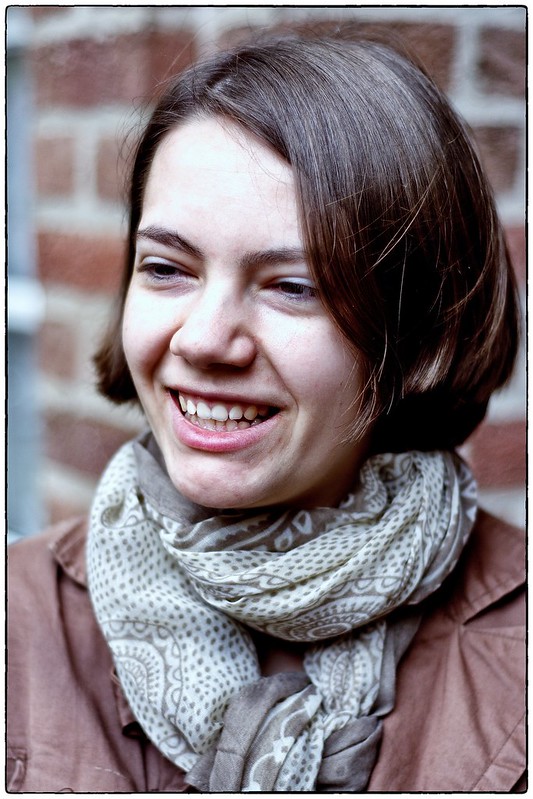
A nne

Anne

Intermediate School Teacher

“I come from a long line of teachers and did not plan to be one, but found I enjoyed it. I went to graduate school when I started seeing students struggling with reading at the expected level, and realized I wasn’t completely sure how to teach it.”

Anne is a white, 40 year old woman who teaches middle school in the District of Columbia. She has degrees in English and Education, and jokes she went from a fairly liberal women’s college for undergraduate work to a very conservative university for graduate work, with a dress code that included not having bare shoulders.

Anne started teaching as a job, not a profession, until she realized she enjoyed it and wanted to learn to become a better educator. She has worked in a variety of school systems, in her current position she is working with predominantly minority students.

Anne’s day includes lesson preparation and teaching English as a Second Language in a diverse school system. She uses computer based learning, but it concerned that it is more rote learning and seeks materials that will encourage her students to learn more and improve reading skills and comprehension.

Audience and Content

Several years ago, my father visited me in Northern Virginia. Living just outside Washington, D.C., finding something he would be interested in seeing was rarely difficult. He asked me to take him to the Smithsonian’s Steven F. Udavr-Hazy Center in Chantilly, with a specific aircraft in mind. Dad wanted to see the Vietnam era Cessna O-1A BIRD DOG. We found it suspended in one of the side halls, and something happened I did not expect. My father served in Vietnam as an advisor to the Vietnamese Navy, but never spoke much about it until the early ‘00s. That day in the museum, looking at this tiny plane that carried observers and Forward Air Controllers, he started telling me about his jaunts as a passenger during the war.  As he was sharing his exploits, I noticed out of  the corner of my eye people were edging toward us, eavesdropping. The BIRD DOG, for a few minutes, was more than an exhibit, but lived again for my father and his small audience, it once again flew over the Mekong River Delta with a daring pilot and his passenger. 

At the time, I thought it made a sweet and charming story, of my father sharing his experiences and accidentally educating other visitors. It is not Grele’s central idea, however in his closing paragraphs he says this about public history: “It promises us a society in which the broader public participates in the construction of its own history.” In any public history project, how the audience relates to the content is a critical component.1

The title Grele chose for his discussion of public history is on point for thinking about the relationship between the audience and content, asking “Whose Public? Whose History…” Although his main ideas relate more to defining and understanding what is a public historian and their changing roles within the community of historians, he touches on the relationships, offering public history projects and practitioners as guides in how the audience accesses and uses content to develop their own knowledge and help shape their understanding of the world. 

Corbett and Miller’s “A Shared Inquiry into Shared Inquiry” offers several examples of how the audience and content, and sometimes funding, create opportunities and tensions when developing content. It was the anecdote Corbett begins the article with that made me think of my father’s visit. She is interviewing a woman to better the documentation behind some photographs, who identifies one as being herself and sister.  This led to wider involvement with the community Corbett was studying and a richer understanding of the history. Corbett explains as the interviews continued she and her subjects shared the inquiry and authority over how the content developed. The exhibit made these women feel like partners in the endeavor, although she kept the decision making authority. In this case, the audience led to a fuller story than could be told otherwise.2

Understanding how the audience will use the content, in both the physical and intellectual way can drive what content is presented. Histories of the National Mall had to decide who the audience for the site would be, the best means of getting the information to them, and the sustainability of the content. By selecting visiting tourists as a primary audience, the project had to start with the best platform for accessibility, choosing to develop an Omeka site viewable on a smartphone instead of an application, and the wifi support for visitors to the Mall. Content was arranged to allow the audience to choose what they were interested in learning more about (personally, I’m intrigued by the Cherry Tree Protest).

Audiences and content should not be separated in planning a public history project as they affect each other. In considering content, the effect on the audiences is an important factor – will it inspire, trouble, educate, entertain, welcome or exclude the intended audience. Similarly, the desired response of the audience is equally important, as well as how the content is displayed and accessed.3

  1. Ronald J Grele, “Whose Public? Whose History? What is the Goal of a Public Historian?” The Public Historian, Vol 3, No.1 (Winter 1981, p. 48 ↩︎
  2. Katherine T. Corbett and Howard (Dick) Miller, “A Shared Inquiry into Shared Inquiry,” Public Historian, Vol 28, No. 1 (Winter 2006) at http://www.jstor.org/stable/101525/tph.2006.28.1.15, pp. 15-16. ↩︎
  3.  Cherry Tree Protest at Jefferson Memorial Site,” Histories of the National Mall, accessed March 4, 2024, https://mallhistory.org/items/show/208. ↩︎