Category Archives: Uncategorized

(Re)Defining Digital Humanities

In September, I provided a definition of digital humanities that truly needs revisiting and revising, due to both feedback and questions on the definition and due learning(reconsider word) over the past several months. My original post can be found here: A Definition of Digital Humanities | Online Portfolio (kejacobsen.com) or in the posts listed to the left.

I took a trip down the Google rabbit hole after seeing the term “transdisciplinary” in a definition for digital humanities while rereading Burdick, et. al. I had probably read it as interdisciplinary, the term mostly used in related writing. Transdisciplinary, according to Radakovic, refers to “a research or educational approach that seeks to challenge disciplinary boundaries to create a holistic perspective that provides opportunities to connect across scientific and nonscientific communities1.” Given its roots in computing for the humanities and its expansion into multiple forms of media and digital tools, the idea of a holistic approach resonates with me. Exploring several types of digital humanities over the semester has helped develop a better understanding of the scope of the field. It has still left me with some questions I am still not sure of the answer.

For a definition, Digital Humanities is a collaborative, transdisciplinary field that uses digital tools and methods in research and presentation of studies in the humanities. The humanities can be understood as the study of things humans have created. It can be literature, history, religion, law, linguistics or the arts.2 Based in computing and computer technologies, digital tools offer methods of understanding, exploring, analyzing, sharing and presenting information and research. Digital humanities projects use the same tools to educate and engage audiences, often including the general public. The unanswered question is where is the line between a humanities project presented digitally and a digital humanities project? 

In an earlier post, my experience with building a community through shared love of a podcast led to a question on what about podcasts, or crowdsourced projects for that matter, causes that effect. The transdisciplinary nature of those mediums may be the answer, as they add a social element to digital humanities. They can be perceived as establishing a relationship with the user that engages and draws them in. Whatever the audience, the strength of digital humanities is finding new approaches to research, analysis and engagement that grow and change with new technologies, regardless of the age of the subject matter.

  1. N. Radakovic, W. I. O’Byrne, M. Negreiros, T. Hunter-Doniger,, E. Pears, & C. Littlejohn . (2022). Toward Transdisciplinarity: Constructing Meaning Where Disciplines Intersect, Combine, and Shift. Literacy Research: Theory, Method, and Practice, 71(1), 398-417. https://doi.org/10.1177/23813377221113515
    ↩︎
  2. Jeffrey R. Wilson, “A New Definition of the Humanities,” Insider Higher Education” October 23, 2023. Online at https://www.insidehighered.com/opinion/views/2023/10/25/new-definition-humanities-opinion ↩︎
Podcasts and the Digital Humanities

Ben Franklin’s World’s gave me COVID.

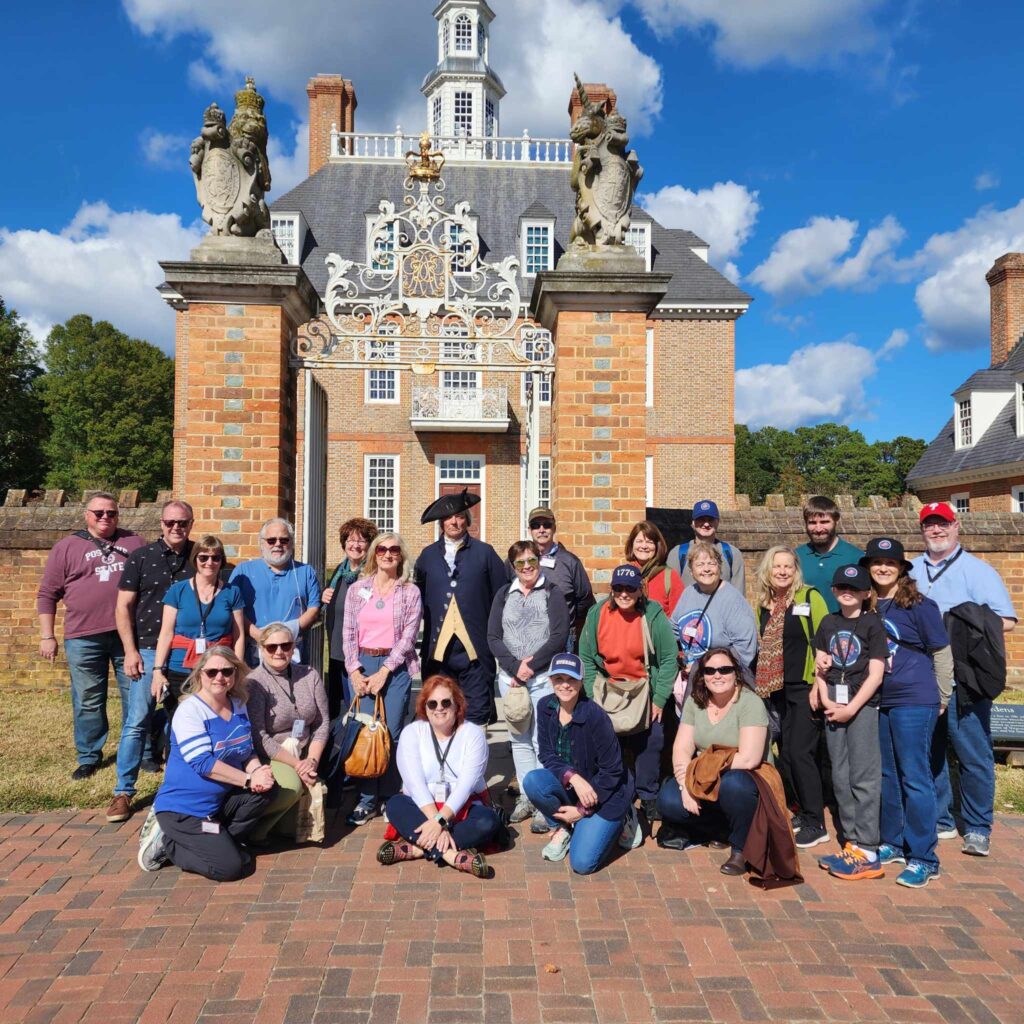
My Zoom book club, a spinoff of the podcast, decided we wanted to do a meet up, in Colonial Williamsburg, to celebrate our group and the podcast that brought us together. After a wonderful weekend, including dinner and a ghost tour with Liz Covart, almost half of us tested positive. We share well, apparently, a weird book and podcast loving COVID cluster.

Ron Carrington as President George Washington with members of Poor Richard’s Book Club, 23 April 2023.

Podcasts allow humanities scholars to engage with the public differently as a medium as they have an ability to reach wide audiences that may not traditionally interact with the digital humanities. In this picture are a music teacher and a professor who teaches teachers, a Canadian farmer and his wife, two lawyers, a family counselor, a nurse, and the Australian contingent, a healthcare advocate, a surveyor, and their son (Ii’m the one kneeling second from the left). A group brought together by a mutual interest in history and a podcast that not only made several people want to read the book discussed, but read it with other people. Podcasting offers an opportunity for humanities scholars to explore and are of their interest and research in way that can be both entertaining and educational. I was introduced to both Ben Franklin’s World and Revolutions as assignments in class. Through another non-scholarly podcast, I started listening to Dressed with fashion historians. And through The Green Tunnel I am learning about the Appalachian Trail even though I despise camping and anything more than and easy day hike.

Podcasts can be an introduction to the humanities, and reach a wide audience due to their accessibility. They allow a digital scholar to present their research or scholarship in a format that anyone can access and they can explore and share areas of interest in smaller, more digestible bites for a public audience. The medium of podcasting allows a more personal connection and engagement with the audience than most others in the digital humanities.

The popularity, reach and the less academic sound of podcasts should not be mistaken for less rigor. Podcasts are as much a tool as the others used in the digital humanities. Like the mapping and visualization tools, it requires its own set of data and research. The product may not be a graphic; it is still a synthesis of data and research. The script writing aspect requires the use databases and search tools as wells as an understanding of permitted use and copyright law. The addition of show notes to most podcasts can tie them further to related tools, as they may be part of a larger humanities project and make use of the other tools to supplement the discussion.

Podcasts are a versatile tool for the humanities scholar, as it can generate interest in a topic or bring in a new audience. They provide the public an opportunity to learn and explore something new and different and can open a door to learning more and exploring other interests. Their availability on the same platforms that most people are listening to music on opens up the potential audience for the podcast and potentially other projects.

And we are all recovered and reading Alan Taylors’s The Civil War of 1812: American Citizens, British Subjects, Irish Rebels, & Indian Allies.

Crowdsourcing the Digital Humanities, Part II

Almost every definition of the Digital Humanities includes that it is a collaborative undertaking. Collaboration is not just with peers, but includes engaging the public in crowdsourcing. Wikipedia is the most visible of the crowdsourcing projects,

We have looked at AI, Wikipedia and transcription projects as examples of crowdsourcing. I prefer transcription for crowdsourcing. Transcription engages the public in a different way than a Wikipedia type project, in that transcription can connect the volunteer on many levels. First, they become part of something larger, and can contribute to spreading knowledge. Crowdsourcing the tasks of transcription brings a lot of potential manpower to a project, but also fosters connection with a collection and its goals. It can also connect a transcriber to history on a more personal level. A volunteer, with good instruction can transcribe and review and engage with artifacts in a completely different way than they are accustomed to. Volunteers can also help with determining the allocation of resources, as projects that more people are interested in working on can also help understand what the public is interested in and inform other decision.

Crowdsourced projects demand engaged participants and retaining participants to meet goals for work accomplishment. Engagement is related to value – making suer the participants feel valued and presenting the project in a way that demonstrated value. Shakespeare’s World and By the People both do this is several ways. While Shakespeare’s World his currently on hiatus for data processing, exploring the site shows some of the ways participant interest can be maintained. The Talk section shows some of the ways participants are engaged. The page includes news, FAQs, help with handwriting, areas of interest to researchers, OED (the project has contributed entries) and Recipes. Recipes invites the participants to try the ones they find and add results for the community.

#Recipes2Try, https://www.zooniverse.org/projects/zooniverse/shakespeares-world/talk/228

Efforts with the researchers and volunteers resulted in working on understanding a recipe with a contestant from the Great British Baking Show, who published on it, and an entry into the OED.1

In By the People, value of the participants in their work comes in several ways. First, the instructions are incredibly user friendly, making it a welcoming site. Using the Car barton Campaign as an example, choosing an item included a comment that the volunteer may be the first one in 100 years to be reading her letterbook — the volunteer is now part of a select group. The project goes on to encourage participants as they grow more confidant, to add doing peer reviews to what they are doing, again recognizing that they are key to not only transcription, but their increasing expertise is trusted to peer review the work.

  1. Van Hyning, Victoria Anne, and Mason A. Jones. “Data’s Destinations: Three Case Studies in Crowdsourced Transcription Data Management and Dissemination.” Startwords 2 (2021)., pp 5-7.  https://startwords.cdh.princeton.edu/issues/2/datas-destinations/
    Links to an external site.
    .

    PreviousNext


    ↩︎

Revisiting the Oregon Trail

I decided to replay Oregon Trail today, after listening to the podcast Ben Franklin’s World. The host, Liz Covart, interviewed Rinker Buck about his book The Oregon Trail: A New American Journey. Buck retraveled the Oregon Trail with his brother, driving a team of mules and a covered wagon. The interview and ideas were intriguing, so I started where he got his inspiration: the game Oregon Trail.

Spoilers, I died. Three times. The farthest I got was just past Fort Boise, the only survivor of my party. Basically, traveling the virtual Oregon Trail with me is a bit like traveling virtually with Tom Hanks. Bad things happen, but without Wilson.

The podcast did get me thinking, though, and changed how I played. Buck makes a compelling argument for mules instead of oxen and how to think about the supplies you carry. I never starved, but lost some oxen along the way. The game doesn’t offer a mule option, even though they are recommended as pack animals along the way, so I was unable to prove his point.

In the half hour or so I spent with the two of them in my ear, I learned about religion and division on the Trail, tragedy and loss, and opportunists. We all load up our wagons to the brim in the game, similar to what our pioneering ancestors did — he explains that many overdid it and found themselves abandoning supplies along the way to lighten the loads. I tried less supplies more hunting, focusing on deer and elk, not buffalo and was continually scolded by the game for hunting, even though I was careful to only shoot one animal per stop. I never starved, but those darn biting snakes…

He also made me ponder the America he met along the way, as he had to find places to stop every day that could accommodate mules. He told Liz about staying in state parks and at rodeos, and of people who heard about him and sought him out to offer hospitality. He met the America we often have as our self-image, open and hospitable. And that was a little heartwarming.

Here’s the link to the episode: https://benfranklinsworld.com/episode-077-rinker-buck-oregon-trail/

I’m adding the caveat here that I have not read his book, yet. I did add it to the reading list I keep, unoriginally titled “Things I Want to Read.” Happy Trails!

Where on the Oregon Trail is Carmen Sandiego

Over the past week, I had the opportunity to spend several hours playing Oregon Trail and Where in the World is Carmen Sandiego (whose henchmen never seemed to get snakebites or measles, unlike my avatar traveling to Oregon). Even with late ’80s and early ’90s graphics and functions, I was completely drawn in and engaged.

Carmen Sandiego provided a healthy geography lesson, as we tracked criminals around the world, guessing their next location based on a series of hints. These hints also worked a level of information analyses, as the player was required to determine the characteristics of the criminal to get a warrant. Even if you caught up in time, no warrant and you failed — a little bit if legal training in there as well.

And then I hit the Trail and learned how to die…

My first run was most successful, dying of dysentary at The Dalles. I’ve had dysentary and even with modern medicine it was pretty miserable, I have the greatest sympathy for the sufferers without antibiotics. My next run ended before FT Laramie courtesy of a snake, followed by an attempt ending in measles. If there ever was a great game to advocate for vaccination, this is it. Historically, I believe the ways to die and probability of doing so before arriving in the Willamette Valley seem to be accurate. the only one I was surprised not to see was scurvy, unless the periodic discovery of wild fruit was assumed to have staved it off.

Oregon Trail as a learning tool, even in its roughest form, has value, as in my short lives as a pioneer I received a geography lesson, lessons in budgeting and supply management, risk management, disease, and history. I particularly found it interesting when the Native American said we should not shoot the bison as they were vital to his people — I found myself hunting deer for some time after that. The “Talk” button provided background on the places; short clues to the challenges of the pioneers, their successes and failures; and a Laura Ingalls Wilder Easter egg.

Oregon Trail 2020 is a game I would play, converted to a first person perspective and with better graphics. Some of the options could include more in depth explorations of the places, such as climbing Chimney Rock or walking around a frontier fort and meeting the people. This would be a great opportunity to introduce Native American stories or those with more diverse backgrounds, such as the Buffalo Soldiers. The map the Trail itself and your progress should have updated graphics. One change I would not make is the tracker tells you have far you have gone, and how far to the next landmark but not to the end. At first, this was frustrating not to know, but then the pioneers would not have have a good idea either, and the unknowing grew on me as a part of the experience.

I also want to name my oxen. This sounds small, silly and superficial. I went through 16 oxen in three tries, of which I died before only two of them. The oxen were a critical part of the journey (play and see what happens when you have none). I was thinking of this as reading about the Donner Party, different trail and lots of bad choices, the author of the book commented that when they reached the point the oxen had to be slaughtered it was hard on them as they had been through so many hardships together at that point, the party was emotionally attached to the animals (Michael Wallis, The Best Land Under Heaven: The Donner Party in the Age of Manifest Destiny).

Update: Played The Oregon Trail Deluxe, 1992.

Environmental Scan

The emancipation of millions of enslaved people during and following the Civil War led to a wide variety of outcomes for them as individuals, families and communities. The stories of these people and their struggle to adapt and fight for the rights of full citizenship have been told in many ways, including Hahn’s A Nation Under Our Feet and in the Federal Writers’ Project in the 1930’s. In the years since many plantations were divided or sold, and in many cases effectively ceased to operate as entities, many of them have become tourist attractions, for the gracious houses and lovely gardens. A trend in the past decade has been to add the stories of the enslaved to the narrative from Charleston’s Middleton Place to the more recent acquisition of McLeod Plantation down the road from it. Both locations strive to include the lives of the enslaved people who worked and built lives there.

https://www.cnn.com/2015/07/17/us/charleston-race-one-girls-view/index.html

This project seeks to develop a tool to identify where the enslaved people came from, and equally important, their fates after emancipation. Conceptually, the project would focus on the South Carolina Lowcountry as a test platform. Several archival and databases are available as a resource, to include the following:

http://www.informationwanted.org

http://www.hastac.org

http://dsl.richmond.edu/emancipation/

https://www.ccprc.com/1447/McLeod-Plantation-Historic-Site

https://www.middletonplace.org

http://www.draytonhall.org

https://www.loc.gov/collections/slave-narratives-from-the-federal-writers-project-1936-to-1938/about-this-collection/

https://www.archives.gov

Thoughts on databases (repost)

The very idea of creating a database can be as terrifying as the month of October, awash in pink and orange. Development of historical databases can provide an important analytical tool and serve to highlight relationships that are not readily apparent — and conversely disprove them. To make the best use of a database, the user needs to have an understanding of the issues peculiar to developing ones for historical use.

Inconsistency and changes in the spelling of names can change how data is retrieved. Take my name for example, Kristin. Variations on spelling include Kristen, Krysten and so forth. My spelling is not the most frequently used, but the Kristen variant is. Building a database record, or searching for one for the name requires both recognition that there are alternate spellings and that a name can be easily misspelled.

Changes in the landscape and boundaries over time have to be accounted for in an historical database as well. Landscape changes due to erosion and accretion, mining, and development are some ways the land can physically change, causing data records that include features of the terrain to become more difficult to enter and locate correctly.

The fluidity of town, county, state and country boundaries and names can add a level of difficulty in database construction and use and requires a familiarity with the changes over time. If you are interested in early 18th century Maine, look at Massachusetts for data as it was part of that colony.

Project Ideas

  • Mapping of historical markers for use in planning walking/running/bicycling
  • Documenting the enslaved populations of a historical site such as McLeod Plantation, when possible to include where they came from and where they went, especially after emancipation