In May 1940, the German Army crossed the border into the Netherlands; five days later the small nation capitulated and the Bezetting, or occupation, began. The Arnhem Postal History Project offers a view of everyday life in this period, through postal covers, postcards, correspondence and documents. The collection consists of several thousand items, this study uses the 86 pieces in the Forced Labor group and four from the Operation Market Garden and the Aftermath group. The data set is made up of postmark information (date and location), addressee names and addresses, sender names and addresses, and where the item went through German censors if marked, and the associated latitudes and longitudes. The project uses kepler.gl to map the items as an experiment in mapping and understanding the data set.
Forced Labor
All of the countries occupied by the Germans had seen impressment for labor in factories and on farms, and as the war continued, replacing those conscripted for military service. Laborers were taken from Russia, Poland, France, Belgium, Denmark, Norway and the Netherlands; the numbers included the Jewish citizens of those nations as well, forced to labor in the concentration camp system.
In the immediate aftermath of the invasion and early days of the occupation, Dutch prisoners of war were used to clear rubble and do repair work while awaiting disposition.1 Attempts to recruit volunteers met with limited success, leading to impressment of civilians for labor details, both small and large. Among the ways of increasing manpower was the Opbouwdienst, a program to keep discharged soldiers employed through working on roads and drainage. The program became the Nederlandse Arbeidsdienst (NAD) that offered exemption from being sent to Germany for six months’ service. By the spring of 1942, NAD service was compulsory, with harsh punishment for those who tried to evade it, or avoid being called for service in Germany. 2
Conscripted workers worked in factories, on farms, on the construction of defenses (for example the “West Wall” defensive positions in the Netherlands and Denmark), and public works projects. While some did choose to volunteer for work with the promise of better pay and food, much of the labor did not. The workers suffered poor working conditions and risked injury or death from the Allied bombing campaigns.
The tremendous losses suffered during the Russian campaigns as the war progressed, particularly the loss of 500,000 men at the Battle of Stalingrad, put a strain of German resources. The necessity of raising more troops and replacing lost equipment from that campaign increased the demands from commerce and industry to make up the shortfall in labor. This labor shortage led the German authorities in occupied countries to ramp up efforts to recruit or conscript workers.
When larger number were needed, German authorities conducted razzia (raid), rounding up men in the streets and at home. Men and women rounded up in the razzias were impressed into labor predominantly in Germany. Men were required to register and report for voluntary work, and when that failed, razzias were used to fill the quotas.
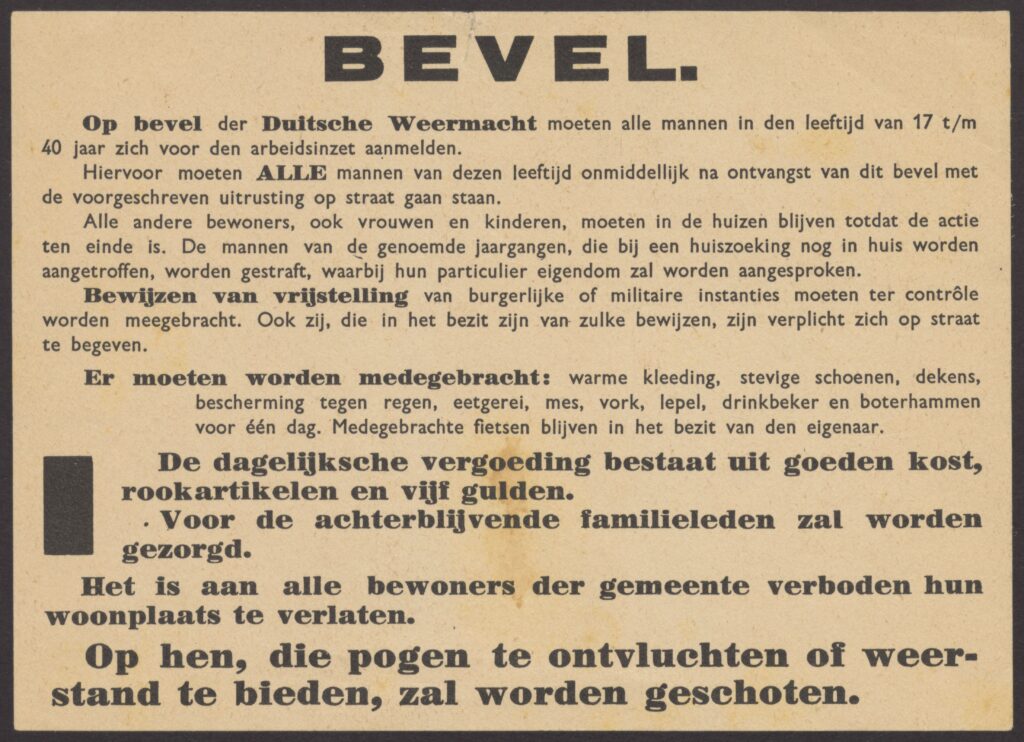
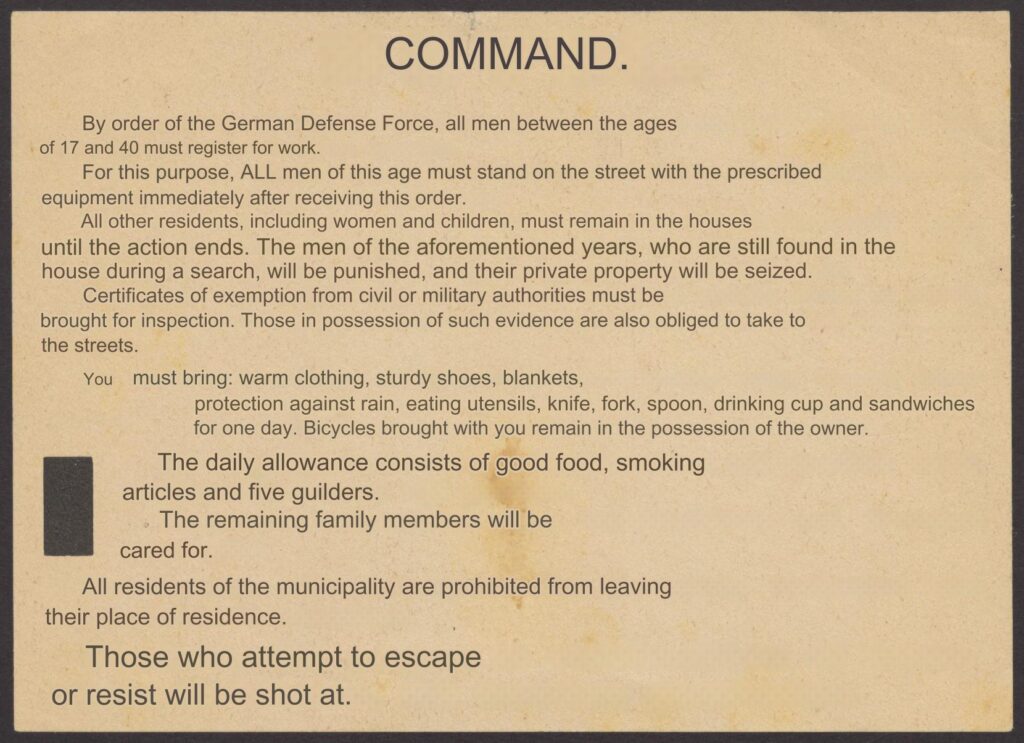
One of most notorious razzias occurred in Rotterdam November 10-11, 1944, which rounded up 52,000 men for service in agriculture and industry in the eastern provinces of the Netherlands and Germany. During “Aktion Rosenstock” all roads and bridges out of Rotterdam and Schiedam were cordoned off, preventing escape from the cities. 3
Correspondence to and from Labor Camps
Using a sample size of 90 items from the Operation Market Garden and Aftermath and Forced Labor (volumes I and II) from the Arnhem Postal History Project, we can get a snapshot of what forced labor looked like to the families and friends of those sent to other location in the Netherlands or Germany for work.
Map 1: Routes taken by correspondence and volume over time
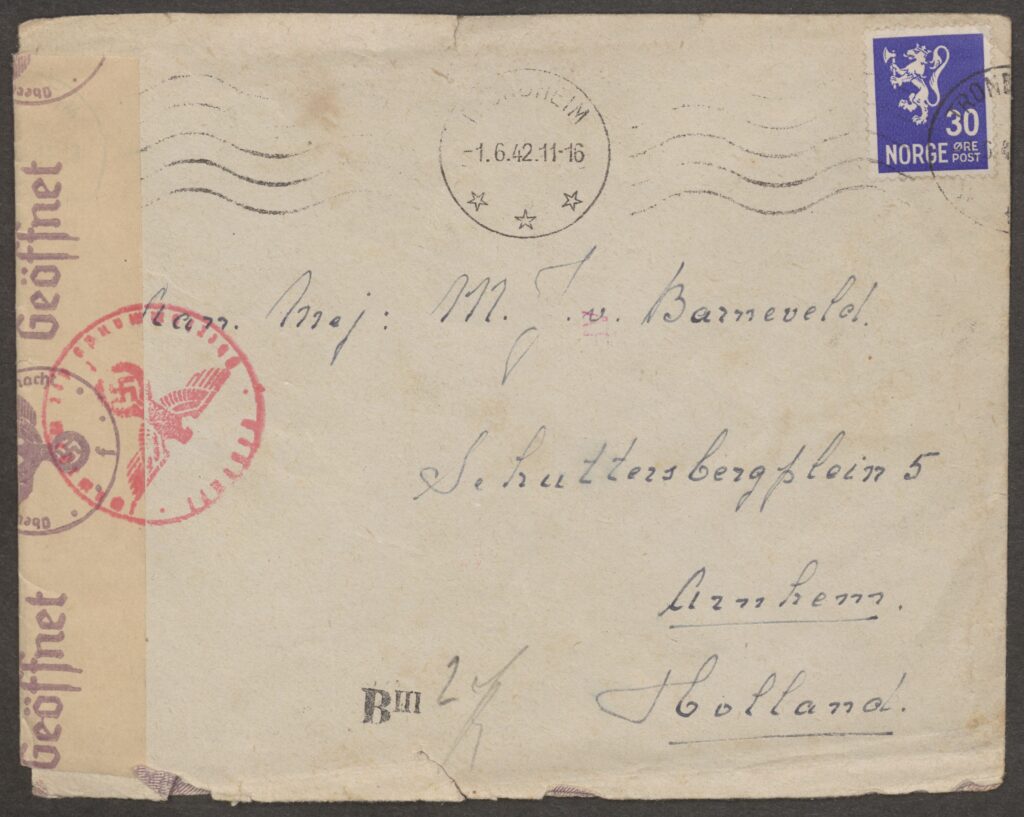
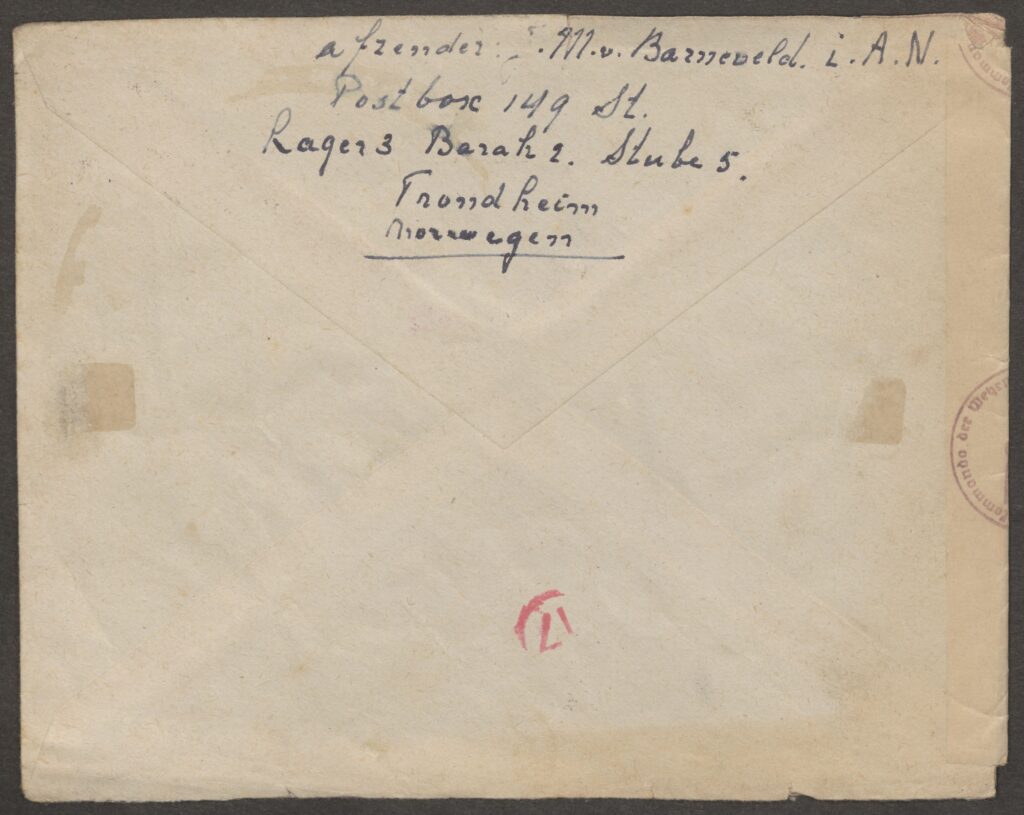
Map 1 is an overview the ninety pieces, this shows the breadth of the forced labor programs, with correspondents not only in the Netherlands, but as far away as Trondheim, Norway. The Trondheim piece is the earliest of the group, unfortunately the letter that accompanied the postal cover was lost.
Map 2: Cluster graph of sender locations
Map 3: Cluster graph of addressee locations
Maps 2 and 3 break out the locations of both the senders and the addressees.
A close examination of the Map 1 will show a some outliers of interest; there are a few arcs connecting labor camps to each other. The correspondence was between J.J. Buurma, forced to work in the Mauser armament factory near Berlin, and J.J. (Hans) Sprey, in the Mauser factory in Oberndorf am Neckar. The second pair was Arie Pot, at a camp near Munich, writing to L. (Bertus) Ruijt in a factory near Köthen.
Map 3: Burma and Pot letters
Censorship
All media and mail in the Netherlands was subject to German regulation and censorship. Most of these items were censored in Cologne, Germany, with the exception on one piece, again the Trondheim cover, censored in Hamburg.
Map 4 below is a visualization of the effect of censorship. The red lines trace the correspondence from the sender to the censor’s location, in these examples either Hamburg or Cologne. The green lines represent the movement from the censor to the destination.
Map 4: Effect of censorship on correspondence pathways
Although several items have additional postmarks that indicate passage through the censors was frequently fairly fast, the omnipresence of the state ensured control of information throughout.
Challenges: Mapping the Data Set in Kepler.gl
Mapping the data set included several challenges related to georeferencing and quantity of data for visualizations.
Georeferencing turned out to be more difficult than anticipated, in part due to many of the addresses being simply a camp name. The visualization still works, mapping to the city or town named on the item, but for granularity it would be a problem. Georeferencing in both Excel and Google docs required add ins, I used a free script from GitHub and created the extension in my Google doc.
The sample size of the data set created two challenges. Setting up the kepler.gl filter for the timeline had a steep learning curve, as my first several tries failed. Working through the problem, I had to shift to month/year instead of month/day/year. The second challenge of the data set was that the bulk of the collection was related to four separate groups of people, accounting for 59 of the 90 items and lines. The effect of this was fewer distinct lines of travel for the items.
| Person 1 | Person 2 | Forced Labor Assignment | No. Items |
| Louis Bernaards | Marie Pilings/Andrea Bernaards | Worker in Mauser factories | 14 |
| T.J. Verseveldt | Gezina Cornelia Sjouke | Worker at BMW airplane engine plant | 19 |
| Hendrik van der Zee | J. and A.J. van der Zee | Worker in Mauser factories | 22 |
| Dik den Otter | E. den Otter | Razzia after Operation Market Garden | 4 |
Map 5: Correspondence paths filtered by largest groups of correspondents
Conclusion
The Arnhem Postal History Project collection offers insight into both the postal history and the social history of the Netherlands. The Forced Labor group, although a small sample size, demonstrates the effect of German labor policy in occupied countries, sending men to factories in German, usually involuntarily. Censorship created delays in mail delivery, adding to the challenges of separation.
Kepler.gl was an effective tool to visualize the data. The size of the data set limited what conclusions could be drawn, but the maps did provide a good snapshot. The layers and filters allowed different views of the information to help develop further lines of research, such as a drill down on the correspondence between men in labor camps writing each other. Overall, kepler.gl worked well to map the correspondence and is a useful tool for digital humanities projects.
- Paul Glaser, Dancing with the Enemy: My Family’s Holocaust Secret, 38–41. ↩︎
- Kees Adema and Jeffrey Groeneveld, , The Paper Trail: World War II in Holland and Its Colonies as Seen through Mail and Documents, 277–84. ↩︎
- The Razzia of Rotterdam (stichtingreisvanderazzia.nl) ↩︎
